Most of us learned how to hold a pickleball paddle by copying whoever handed us our first one, then never thought about it again. It is worth ten minutes. The grip you use decides whether you can defend a speed-up at the kitchen, and the size of the handle decides whether it is your hand or your elbow that aches after three games.
Here is the grip to start with, the two alternatives and what each one costs you, how to check your own grip size, and what the handles on the paddles we actually hold in Australia measure. The last part is the bit nobody publishes, so we pulled it straight off our own product records.
How to hold a pickleball paddle: the continental grip
Shake hands with the paddle. That is genuinely the whole instruction: hold it as though you were greeting it, with the face vertical and the edge leading. For a right-hander the knuckle of your index finger sits on the top-left bevel of the handle. Nothing about your hand changes between a forehand and a backhand.
That last sentence is the reason the continental grip wins in pickleball. A speed-up at the kitchen line arrives in roughly a third of a second. There is no time to rotate your hand a quarter turn and get the face square, so the grip that is already neutral for both wings is the grip that blocks the ball back. Tennis players can afford to switch because they have a bounce and a run-up. You do not.
If you are learning on something forgiving, a wide face helps while the grip is still new: our beginner pickleball paddles are all easy to square up.
Eastern and western, and what they cost you
Eastern turns your hand a touch towards the forehand side. You get a more natural topspin drive and a heavier forehand, and you give up the backhand: the face closes, and your block at the kitchen becomes a guess. It is a reasonable trade for a baseline-heavy singles player and a poor one for club doubles.
Western turns further again. Huge forehand topspin, and a backhand that is close to unplayable without changing grip mid-point. Almost nobody can make that switch at the speed the kitchen moves. Skip it.
The honest warning is for the tennis crowd, and we get a lot of you: you already own a semi-western forehand and your hand will keep sliding back to it. Resist for the first month. There is more on what carries over and what does not in our guide to pickleball versus tennis.
The real mistake is pressure, not grip style
Nine times out of ten when someone's hands look bad, it is not the grip. It is the squeeze. Aim for about four or five out of ten, firm enough that the paddle does not turn on contact and loose enough that your wrist can still move.
White knuckles are what kill the soft game. A tight hand cannot absorb pace, so every reset pops up and every third-shot drop sails. If your drops keep floating, check your grip pressure before you change your paddle.
One optional tweak: some control players lay the index finger up the back of the handle, a bit like a table tennis grip. It adds feel on dinks and costs you a little stability on a hard drive. Try it, keep it or bin it.
How to check your grip size
Open your playing hand, palm up. Measure from the middle crease of your palm to the tip of your ring finger, in inches. That figure is roughly the grip circumference you want. Most adults land somewhere between 4 and 4 1/4 inches.
Then the rule that actually matters: when you are between sizes, go smaller. You can build a handle up with an overgrip in thirty seconds. You cannot shave one down. A handle that is too big also stops you rotating the paddle to brush up the back of the ball, which is where your spin comes from, and it is the usual suspect when a forearm starts to complain.
What our range actually measures
Here is every published grip figure on a selection of paddles we currently hold, pulled from our own product records on 25 September 2026.
| Paddle | Handle length | Grip circumference | Price |
|---|---|---|---|
| Franklin C45 Anna Leigh Waters 12.7mm | not published | 3.9 in | $379.99 |
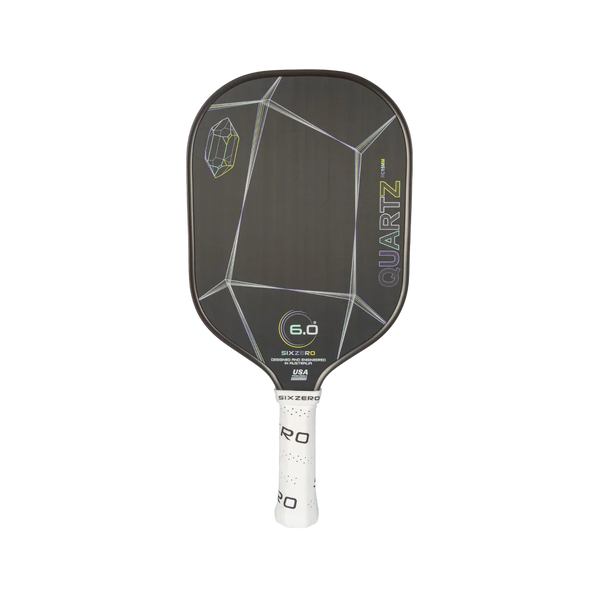
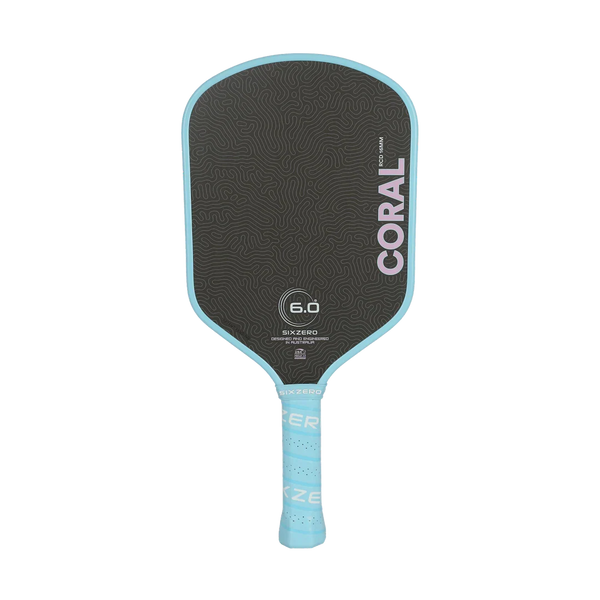
| Six Zero Coral Light Weight 16mm | 5.5 in | 4.0 in | $275.00 |
| Luzz Glider 2026 Hybrid 16mm | 5.31 in | 4.13 in | $159.00 |
| Honolulu J2CR Crystal Blue, Regular Handle | 5.5 in | 4.125 in | $308.00 |
| Honolulu J2CR Crystal Blue, Extended Handle | 6.0 in | 4.125 in | $308.00 |
| Six Zero Quartz | 5.0 in | 4.25 in | $99.00 |
| Friday Fever 102 Gen 3 (Snow) | 5.5 in | 4.25 in | $175.00 |
| Aireo Cyclone | 5.7 in | not published | $312.00 |
Look at the circumference column. The entire active range fits between 3.9 and 4.25 inches, a spread of about nine millimetres. Grip size is a genuinely smaller decision than the internet makes it, and if you are inside that band you are fine on any of them. A $99 Six Zero Quartz has a thicker handle than a $379.99 Franklin C45, which tells you price has nothing to do with it.
Two honest gaps in that table: Franklin publishes circumference and not length, Aireo publishes length and not circumference, and Selkirk gives us a single 4.25 in figure with no handle length at all. We are not going to invent the missing numbers, so those cells stay empty.
Pickld carries every brand named here. The figures are the manufacturers' published specs as recorded against our own products, not affiliate picks.
Handle length changes far more than circumference
Now look at the other column. Handle length runs from 5.0 inches on the Quartz to 6.0 inches on the J2CR Extended, a full inch. That is the spec that actually changes how you hold the paddle, because it decides whether a second hand fits on the handle at all.
If you play a two-handed backhand, you want 5.5 inches at the very least and you will be happier at 5.7 or 6.0. If you are one-handed, a longer handle mostly just moves face area you could have been hitting with down into the grip, and a shorter handle buys you a larger, lower sweet spot.
The Honolulu J2CR is the cleanest way to see it: the same paddle, the same $308, the same 4.125 inch circumference, in a Regular Handle at 5.5 inches and an Extended Handle at 6.0 inches. Nothing else about the paddle moves. Our J2CR review goes through both side by side if you are choosing between them.
Handle length is the third of three specs worth checking before you buy, alongside paddle weight and 14mm against 16mm core thickness. If you would rather we just narrowed it down for you, the paddle finder asks four questions and gives you a shortlist.
Changing the grip you already have
A replacement grip is the thick cushioned layer fitted to the paddle at the factory. An overgrip is the thin tacky layer that goes over the top of it and gets consumed. You do not remove one to fit the other.
The Pickleball Labs FlexTac overgrip is $6 and 0.7mm thick, in white, black, pink or blue. One wrap builds the handle slightly without changing the size your hand has learned; two wraps is the cheap way to go up a size if you measured over 4 1/4 inches. Most club players get four to six sessions out of one before the tack fades, so if you play twice a week the 3-pack at $12 makes more sense than singles.
If the base grip itself has gone hard, the Pickld Hexacore Grip is the replacement layer at $35, and the Pickld Grip Pack pairs the two for $37.50. For the actual wrapping technique, start-point, overlap and where to finish, our overgrip guide walks through it properly, and the rest of the pickleball paddle accessories worth having are in one place. There is also a wider rundown of what each accessory actually does if you are starting from scratch.
What to do at your next session
Three things, in order. Shake hands with the paddle and keep that grip for the whole point, both wings. Drop your grip pressure to about five out of ten and hit twenty dinks. Measure palm crease to ring finger when you get home, and if you are over 4 1/4 inches, put a second overgrip on rather than buying a new paddle.
Grips and overgrips ship from Sydney, and Australian shipping is free over $150. If you are not sure which handle length suits your backhand, hit reply and tell me whether you use one hand or two, and I will point you at the right one.
Ben