
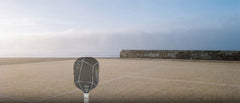

A portable pickleball court is a net, four lines and about 82 square metres of flat ground. That is the whole kit. If you have a double driveway, a backyard slab, a quiet cul-de-sac or a hall with a key, you can have a regulation court standing in under ten minutes, and only one part of it is worth spending real money on.
Here is what it takes in Australia: the real dimensions, how to mark lines without painting anything, the nets we hold in Sydney, and what the whole lot costs.
What a portable pickleball court actually needs
- A net at regulation height. 0.914 m (36 inches) at the posts, 0.86 m (34 inches) through the middle. This is the one part you cannot improvise.
- Flat ground, 13.41 m by 6.10 m. Concrete, asphalt, a sports hall floor, or grass that is short and genuinely level.
- Four lines. Two baselines, two sidelines, and the kitchen line 2.13 m back from the net on each side. Chalk or tape, never paint.
- Balls that match the surface. Outdoor balls outside, indoor balls on a hall floor. They are not interchangeable, and the difference is bigger than people expect.
No posts in the ground. No surfacing. No council form. If you have the space and the net, you have a court.
The space: 13.41 m by 6.10 m, and what to do with less
| Measurement | Metric | Imperial |
|---|---|---|
| Court, singles and doubles | 13.41 m x 6.10 m | 44 ft x 20 ft |
| Kitchen, each side of the net | 2.13 m | 7 ft |
| Net height at the posts | 0.914 m | 36 in |
| Net height at the centre | 0.86 m | 34 in |
| Comfortable surface with run-off | about 18.3 m x 9.1 m | 60 ft x 30 ft |
The court itself is 13.41 m by 6.10 m. USA Pickleball's rulebook asks for roughly 18.3 m by 9.1 m of total playing surface once you allow room to chase a ball off the back, and almost no Australian driveway has that. It does not stop you. A court with 60 cm of run-off still plays perfectly well socially: you simply stop sprinting after lobs, which your knees will thank you for anyway.
Two home setups that genuinely work:
- The long double driveway. A double driveway is usually close to 6 m wide, which is the court width almost exactly. Mark the sidelines at the edges of the concrete and accept no side run-off. You need about 14 m of length, so measure before you buy a net.
- Half a court, on purpose. With 7 m by 6 m you can mark one kitchen, one service area and the first metre of mid-court. That is where most points are decided, so it is better practice than a full court you have to squeeze.
For the full measurements, including the service boxes and how to square the corners with a tape measure, our guide to pickleball net height and court dimensions is the reference. If you have a tennis court to work with instead of a driveway, playing pickleball on a tennis court covers exactly what changes.
The net is the whole decision
Everything else on a home court is cheap or free. The net is the piece that decides whether you keep playing on it in March, so it is worth understanding what you are paying for. The three full-size systems we hold in Sydney, with their maker's own figures:
| Net | Price | Width | Weight | Frame | Warranty |
|---|---|---|---|---|---|
| OnCourt OffCourt PickleNet Oval Tube | $289.00 | 6.7 m (22 ft) | 9.98 kg | Powder-coated steel, patented oval tubing | 1 year |
| JOOLA Elemental | $239.95 | 6.71 m | Bag under 9.08 kg | Interlocking steel legs | JOOLA manufacturer |
| Selkirk SLK Prime Portable | $229.00 | 6.7 m (22 ft) | 8.7 kg | Steel, tension-adjustment straps | 90 days against defects |
All three are about 6.7 m wide, which is wider than the 6.10 m court on purpose: it gives you roughly 30 cm of net past each sideline so a ball clipping the edge still has netting to hit.
The OnCourt OffCourt PickleNet at $289 is the one we would buy for a court that gets used every week. Round tubing rotates: you set a net up square, play for twenty minutes, and the centre has quietly twisted so the tape no longer faces you. OnCourt OffCourt's frame is oval, so the sections can only seat one way, and they guarantee it will not twist. It is also the net USA Pickleball puts its own name on, and the one the Hornsby Kuringai Pickleball Association left us a review for after buying one. Their verdict was three words: "Such a sturdy net!" Nine in stock. Worth knowing before you buy: it is rust resistant rather than rust proof, and the maker is direct about that, so the whole system goes back in the bag and indoors after each session.
The JOOLA Elemental at $239.95 is the value pick. 91.44 cm at the posts and 86.36 cm through the middle, nylon fabric over knotless PE netting, wide bent interlock steel legs, and the whole thing packs into a reinforced bag that weighs under 9.08 kg. Six in stock. If you want a regulation net standing on a driveway for the least money that still survives a summer, this is it.
The Selkirk SLK Prime at $229 is the lightest of the three and has the feature we rate most. At 8.7 kg it is the easiest to lift out of a boot, and its tension-adjustment straps let you pull the sag out without taking anything apart. A portable net earns its keep on the third and fourth game, not the first, and a strap you can re-tension in ten seconds is the difference between a tape still at the right height late in a session and one that has quietly dropped. Selkirk publish its dimensions as USAP approved: 22 feet across, 36 inches at the sidelines, 34 inches in the centre. Only two left.
If you are only drilling, there is a smaller way in. The Franklin DinkNet at $149.99 is a 1.52 m wide aluminium practice net at the regulation 36 inch sideline height. It stands on two flat feet and packs into its own carry bag. It is a drill net, not a match net: two of you dink over it for as long as you like, which is exactly what happened when our sample came out of the box at Hornsby. It is in stock now. If you want to play actual games at home, buy a full-size net instead.
Comparing them side by side is its own job, and we have done it: see our pickleball nets buyer's guide, or browse every one of our portable pickleball nets.
Marking the lines without painting anything
You need four lines plus the kitchen line. In order of how we would actually do it:
- Chalk, on concrete or asphalt. Free, takes fifteen minutes with a tape measure and a chalk line, and washes off in the next rain. Measure the diagonals to square it: both corner-to-corner diagonals of the court should come to 14.73 m. If they match, your corners are square.
- Gaffer or cloth tape, indoors. On a hall floor, 50 mm cloth tape lifts cleanly and does not leave the residue duct tape does. Ask the venue first, always.
- Marker cones or discs, on grass. You do not need continuous lines to play socially. Eight flat discs, one at each corner and at the ends of each kitchen line, and everyone can see the court.
What we do not stock, and we would rather say it than have you hunt: Pickld holds no court line markers, marker discs or line-tape kits. A hardware-shop chalk line and a roll of cloth tape will do the job for about $25, and if there is enough appetite for a proper court marking kit we will look at bringing one in. Tell us if that is you.
Surface: what plays and what does not
- Concrete and asphalt. The best home surface by a distance. Ball bounce is true, lines go on with chalk, net legs sit flat.
- A sports hall floor. Excellent, but switch to indoor balls. Indoor and outdoor pickleballs behave differently enough that playing the wrong one indoors ruins the game and, eventually, the ball.
- Grass. Playable if it is cut short and genuinely flat, but the bounce dies. Expect a slower, dinkier game, and expect to lose balls in the garden.
- Gravel, pavers with lips, anything sloped. Do not bother. An uneven bounce at the kitchen line teaches you bad habits.
Getting a court standing in one box
If you are starting from nothing, the Selkirk net plus two Quartz paddles plus a dozen Franklin balls bought separately comes to $474.95. Our sets hold the same gear and are priced under that:
- Pickld Value Set, $418.95. The Selkirk net, two Six Zero Quartz paddles and Franklin balls. Two players, one box, a court. Eight in stock, and four of the five colourways are available.
- Pickld Court Set, $617.95. Same net, four paddles. This is the doubles answer, and it is what most families and share houses end up buying. Six in stock.
Want to pick the pieces yourself? The Six Zero Quartz at $99 is the carbon paddle we put in both sets and the one we hand people who have never held a decent paddle, with 102 in stock across four colourways. Franklin X-40 outdoor balls are $47.95 for a dozen and are the standard outdoor ball in Australia. Or browse the pickleball sets, the beginner pickleball paddles and the pickleball balls and build it your way.
What a home court costs
| Setup | What you get | Cost |
|---|---|---|
| Drill corner | Franklin DinkNet, a dozen balls, paddles you already own | about $198 |
| Two-player court | Pickld Value Set: net, 2 paddles, balls | $418.95 |
| Doubles court | Pickld Court Set: net, 4 paddles, balls | $617.95 |
| Lines | Chalk line and a roll of cloth tape, from a hardware shop | about $25 |
Free AU shipping over $150, excluding bulky items. A full-size net is a bulky item: freight is worked out to your delivery address at checkout rather than averaged into the sticker price, because we would rather keep the price down for the clubs and councils buying several. Everything ships from our Hornsby warehouse, and pickup is by arrangement if you are local.
Questions we get
Can I play on a smaller court?
Yes, and plenty of people do. Keep the net at regulation height and keep the kitchen at 2.13 m, because those two numbers are what make the shots transfer. Shorten the baselines if you have to.
Do I need a regulation net, or will any net do?
You need regulation height, or everything you practise is wrong by the time you get to a club. 0.914 m at the posts, 0.86 m at the centre. A badminton net is 1.55 m, which is not close.
Will the neighbours hear it?
They will. A pickleball off a hard paddle face is a sharp, carrying sound, and it is the single most common complaint about home courts anywhere in the world. If you are close to a neighbour, play in the afternoon rather than at 7 am, and have the conversation before you start rather than after.
How long does setup take?
About five minutes for the net once you have done it twice, and fifteen for the lines the first time. After that the lines are chalk marks you top up, so it is five minutes to a court.
Can I leave the net outside?
No. All three systems are rust resistant rather than rust proof, and the PickleNet's warranty specifically does not cover a system left out. The carry bag is for storage as much as transport.
Where to play if a home court is not on
Not everyone has 14 m of driveway. If that is you, where to play pickleball in Australia lists the clubs and venues by city, and a club session costs a few dollars and comes with better opponents than your household.
Pickld carries the brands featured here. Picks are based on customer order data and product specs, not affiliate incentives. Prices and stock were read live on 9 November 2026.
Measured your driveway and not sure it fits? Send me the two numbers and I will tell you straight whether it works.
Ben