Grab the wrong ball and you will feel it on the first rally: it sails long in a breeze, sits up dead on a gym floor, or cracks after a fortnight. The indoor vs outdoor pickleballs question trips up almost everyone stepping up from a starter set, and the honest answer is short. Outdoor balls are harder, heavier and drilled with more small holes so they hold a line in the wind. Indoor balls are softer, lighter and drilled with fewer, larger holes so they play with control on a smooth surface. Pick for where you actually play, and everything else sorts itself out.
Here is how to read a ball at a glance, which one suits your court, and the balls we stock and post from our Australian warehouse for each.
Indoor vs outdoor pickleballs: the one-look tell
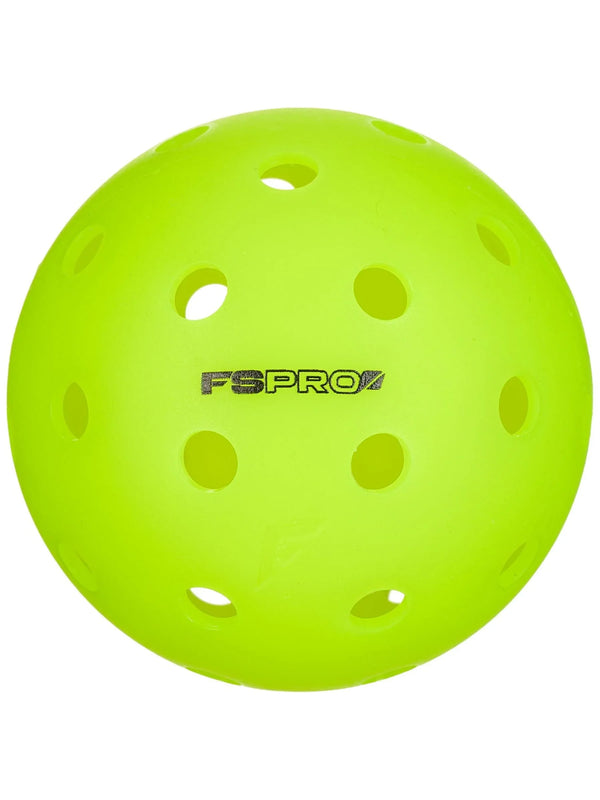
You can tell an indoor ball from an outdoor ball without reading the box. Count the holes.
- Outdoor balls run about 40 small, precisely drilled holes. The Franklin X-40 outdoor pickleball has exactly 40. More holes, smaller diameter, means the ball cuts through moving air and holds its flight when there is a breeze across the court.
- Indoor balls run about 26 larger holes. The Franklin X-26 indoor pickleball has 26. Fewer, wider holes give a softer, slower flight that is easier to control under a roof where there is no wind to fight.
The plastic is different too. Outdoor balls are built harder, usually as a one-piece moulding, so they survive rough acrylic and concrete and resist cracking in the cold. Indoor balls are softer, often a two-piece build with a seam, which gives that gentler feel and a quieter bounce on a sprung timber floor. Harder ball, faster and higher bounce; softer ball, lower and more controlled. That is the whole trade in one line.
Quick rule: playing outside on hard court, in any wind: outdoor ball. Playing inside on a gym or sports-hall floor: indoor ball. If you genuinely do both every week, a hybrid ball (more on that below) saves you carrying two tubes.
What actually changes between the two
| Outdoor pickleballs | Indoor pickleballs | |
|---|---|---|
| Holes | ~40, small | ~26, larger |
| Feel | Harder, firmer off the face | Softer, more give |
| Build | One-piece, crack-resistant | Two-piece, quieter |
| Flight | Fast, holds a line in wind | Slower, more controllable |
| Bounce | Higher, livelier | Lower, softer |
| Best for | Acrylic, concrete, outdoor clubs | Gym floors, sports halls, quiet training |
Two things follow from that table. First, an outdoor ball on an indoor floor plays hot and bouncy, and it is loud, which some venues will not thank you for. Second, an indoor ball outdoors gets shoved around by the lightest breeze and scuffs quickly on abrasive court. Neither is dangerous, it just makes the game feel off. Match the ball to the surface and your touch shots start landing where you aim them.
What makes a pickleball a pickleball
Whatever surface you play on, a regulation pickleball ball sits inside a tight set of numbers. Diameter runs roughly 74mm (the JOOLA Primo is bang on 74mm), weight sits in a narrow band that keeps flight consistent, and the hole count falls between the mid-20s and the low-40s depending on indoor or outdoor design. A ball built to those specs and passed by USA Pickleball (USAPA) is what you will use in any sanctioned comp, which is why "tournament approved" is worth looking for even in social play: it means the ball flies and bounces the way the game is designed around.
The takeaway for buying is simple. Indoor and outdoor balls are both regulation, they just optimise different ends of that spec window, one for a still hall and one for a breezy court. So you are never choosing a "worse" ball, only the right tool for your surface. With that settled, here are the ones we stock.
Best outdoor pickleball balls in Australia
Most Australian club and social play happens outside on hard court, so this is the tube most players want. The outdoor pickleball balls we stock are the tournament standards, the same balls you will meet at organised events.
- Franklin X-40 Outdoor (12-pack, $47.95). The 40-hole X-40 is the official ball of the US Open Pickleball Championships and USA Pickleball, and it is the ball a huge share of tournaments run. One-piece polyethylene build to resist denting and cracking, neon optic yellow so you can track it in bright light. If you want to practise with what you compete on, this is the default pick.
- JOOLA Heleus Outdoor (from $19.95). JOOLA's outdoor tournament ball, developed through repeated on-court testing. A solid alternative if your club or comp runs JOOLA.
- JOOLA Primo (from $17.95). A USAPA-approved 74mm outdoor ball that works nicely for recreational and comp play, and it is the friendliest on the wallet of the three when you are buying in bulk for a group.
All three are outdoor-first. If your regular court is exposed and windy, the X-40's tighter hole pattern is the one that will feel most predictable.
Best indoor pickleball balls in Australia
Winter play, sports-hall bookings and anyone training at home all point to indoor pickleball balls. Softer, quieter, more control.
- Franklin X-26 Indoor (12-pack, $49.99). The 26-hole X-26 is USAPA-approved for indoor tournament play, with a two-piece build and beveled holes for even rotation and a controlled flight on smooth floors. This is the natural indoor partner to the X-40 if you like staying in one brand across both surfaces.
- Pickld Silent Pickleball (from $6, 3-pack $15). Our own quiet foam ball, made for indoor training where noise matters: garages, apartments, early mornings, kids' sessions. It keeps tournament-spec dimensions and weight so your timing carries over to a real ball, but it lands soft and near-silent. Not a match ball, a practice ball you can actually use indoors without annoying the household or the neighbours.
If your "indoor" is really a home drilling setup rather than a booked hall, pair the Silent foam ball with a rebounder or a machine and you can groove your hands-speed without a single loud pop.
Play both? The hybrid option
Plenty of us play outside in summer and move indoors when the weather turns. Rather than carrying two tubes, a hybrid ball splits the difference.
The Selkirk SLK Hybrid (from $12.95) is a 40-hole design built to fly true both indoors and out, with a seam-welded construction that holds up better than a typical two-piece ball. It is not going to beat a dedicated X-40 in a gale or a dedicated X-26 on a dead floor, but for a player who bounces between surfaces week to week, one tube that does both is the sensible call. Have a look if you are tired of owning two of everything.
How many should you buy, and do they wear out?
Outdoor balls are a consumable. Hard court and cold weather crack them eventually, and a cracked ball goes soft and unpredictable, so keep a few spares in the bag. A 12-pack is the right unit for a regular player or a social group; singles and small packs are fine if you are just topping up. Indoor balls last longer because the surface is kinder, but they will scuff and soften over a season of heavy use.
A quick check: if a ball has an obvious crack, a soft spot, or it has gone out of round, retire it. You cannot dink accurately with a ball that no longer bounces true, and it is the easiest fix in the sport. Browse the full range on our pickleball balls collection, all stocked here and posted from our Australian warehouse, with free shipping over $150.
FAQ
Can I use an outdoor ball indoors? You can, but it plays fast and bounces high on a gym floor, and it is loud. Fine for a casual hit, not ideal if you want your indoor touch to translate to comp.
Can I use an indoor ball outdoors? Only on a still day. The lighter build and larger holes mean any breeze pushes it around, and abrasive court scuffs it quickly.
Why do outdoor balls have more holes? Smaller, more numerous holes make the ball more aerodynamically stable, so it holds its line in wind. Indoor balls do not fight wind, so they use fewer, larger holes for a softer, more controllable flight.
Are these tournament legal? The Franklin X-40 (outdoor) and X-26 (indoor) are both USAPA-approved for tournament play, as is the JOOLA Primo. The Pickld Silent foam ball is a training ball, not a match ball.
Still deciding on the rest of your kit? If you are kitting out from scratch, our pickleball set guide pairs paddles and balls into ready-to-play bundles, and if you are setting up a home or club court, the pickleball nets buyer's guide covers the net side. For a deeper dive on Franklin's ball range specifically, see our Franklin pickleball balls guide.
Pickld carries the brands featured here. Picks are based on how the balls play and real customer order data, not affiliate incentives.
Ben