
Most Australian players spend weeks agonising over a paddle and about thirty seconds choosing a ball. Then they wonder why their drives sail long in the Brisbane heat, why their dinks bounce funny on a cold Melbourne morning, or why the bag of cheap balls they bought from a US site cracked in three weeks. The ball you play with shapes more of your game than you think. And in Australia, with our hard outdoor courts, summer heat, and indoor venues that swing from carpet to polished sport floor, ball choice actually matters.
This is our 2026 buying guide to the Franklin range (the X-40 outdoor and X-26 indoor), both of which we stock at /collections/balls. Franklin is the brand that quietly became the default for serious AU club and tournament players, and there's a reason for it.
Outdoor vs indoor: it's not a marketing trick
The first decision is honestly the only one that matters. Outdoor and indoor pickleballs are genuinely different objects, and using the wrong one is a fast way to get frustrated with your gear when the problem isn't your gear.
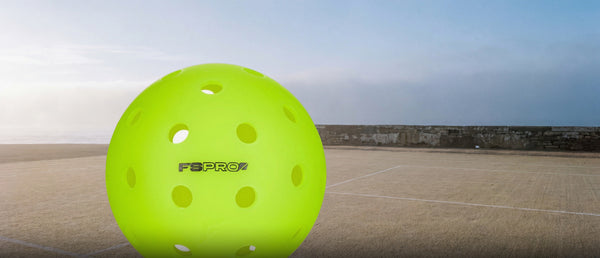
- Hole count. Outdoor balls have 40 small, precisely-drilled holes. Indoor balls have 26 larger holes. Fewer, larger holes = more drag = slower, easier-to-control flight under a roof where there's no wind to fight.
- Hardness. Outdoor balls use harder, denser polyethylene to survive abrasive hard courts. Indoor balls are softer, with a touch more give on a sprung sport floor.
- Weight. Both sit inside the USAPA 0.78-0.935 ounce window, but outdoor balls run heavier in the band to punch through wind.
- Construction. Outdoor is a rotationally-moulded one-piece shell. Indoor is a two-piece bonded construction, beveled hole edges, designed for spin grip rather than wind resistance.
An outdoor ball indoors feels rocketed and loud, with bounces that escape the kitchen. An indoor ball outdoors feels mushy and gets pushed around by even a light breeze. Buy for the surface you actually play on most.
How AU temperatures change the picture
One thing Northern-Hemisphere reviews don't cover: Australian temperature swings. Polyethylene hardens as it cools and softens as it warms. On a 38°C Sydney afternoon a fresh outdoor ball plays slightly softer and a little deader on the bounce; on a 6°C Canberra morning the same ball plays harder and more brittle, and cheap balls will crack on the first hard drive. The Franklin X-40 is engineered for this band: its one-piece moulded construction is the most crack-resistant outdoor ball we stock, and it handles a Sydney summer-to-winter swing without changing character noticeably.
Practical rule: in winter mornings under 10°C, give a fresh ball a few rallies of warm-up before judging it. The ball is genuinely different at temperature.
Franklin X-40: why it's the AU tournament standard
The Franklin X-40 Outdoor is the most-played tournament ball in Australian pickleball, and that's not an accident. It's also the official ball of the US Open Pickleball Championships and of USA Pickleball, which means almost every tournament-bound player anywhere has hit thousands of them.
What the X-40 does well:
- The 40-hole pattern. Precision-drilled holes, evenly spaced, with the trade-off of slightly more wind sensitivity than a 26-hole indoor ball. That's the price of a true outdoor flight pattern.
- Spin response. The slightly tackier surface and edge profile around each hole gives modern textured-face paddles like the RPM Friction Pro something to bite into. Rolls, third-shot drops with kick, and topspin drives all work as designed.
- Durability on hard courts. Sydney and Melbourne courts are mostly acrylic-over-asphalt with a real bite to them. A one-piece moulded X-40 will typically last 6-10 hours of solid rec play before going out of round. Cheap two-piece outdoor balls might give you 2-3.
- Tournament familiarity. If you compete, practising on the ball you'll compete with is non-negotiable. The X-40 is on the USAPA approved ball list for outdoor tournament play, and it's the ball most Australian sanctioned events run.
What it doesn't do: it's not the longest-lasting outdoor ball on the market (a few competitors win on raw durability), and it's not the softest-bouncing: players coming from indoor balls always say their first X-40 session feels lively. That's the ball, not your paddle.
| Spec | Franklin X-40 |
|---|---|
| Surface | Outdoor |
| Construction | One-piece rotational mould |
| Holes | 40 precision-drilled |
| Colour | Optic green / yellow |
| USAPA approved | Yes (outdoor) |
| Pack sizes (Pickld) | 3 / 12 / 100 |
| AU pricing | $12.95 / $47.95 / $325 |
Franklin X-26: when to pick the indoor ball
The Franklin X-26 Indoor is the right ball for a specific group of players: anyone whose home venue is a sports hall, anyone training indoors over winter, and any club running structured indoor sessions.
What the X-26 does well:
- 26 larger, beveled holes. Slower flight, more readable trajectories, and easier control on a sprung sport floor.
- Two-piece bonded construction. Softer feel off the face, slightly grippier surface, designed for spin response on indoor paddles.
- USAPA approved for indoor tournament play. If your club runs an indoor ladder or your tournament is in a hall, this is the ball.
- Visibility. The neon colourway pops against polished sport floors where a dull ball can disappear into the line markings.
Who the X-26 is for: indoor-only players, players doing winter training in halls, clubs running indoor leagues, and anyone whose paddle handling improves when they slow the ball down a touch. If you play 90% outdoors and only occasionally cross into a hall, the X-40 is the better single-ball-bag choice.
| Spec | Franklin X-26 |
|---|---|
| Surface | Indoor |
| Construction | Two-piece bonded, beveled holes |
| Holes | 26 larger holes |
| Colour | Optic neon |
| USAPA approved | Yes (indoor) |
| Pack sizes (Pickld) | 3 / 12 / 100 |
| AU pricing | $14.99 / $49.99 / $349 |
X-40 vs X-26 at a glance
- Outdoors on a hard court? X-40. Don't overthink it.
- Indoor sports hall or carpet? X-26. The outdoor ball will feel wrong.
- Mostly outdoors with occasional indoor? X-40. One ball, slight compromise indoors, fine for rec play.
- Tournament-bound? Buy the ball your event uses. Most outdoor AU events run X-40; most indoor events run X-26.
Pack-size economics: when the 100-pack actually pays
The 100-pack is the question we get most often, and the honest answer is: it depends entirely on whether you're feeding a ball machine.
- Casual player (1-2 sessions a week, social rec). A 12-pack gets you through 2-3 months. Buy the 12.
- Serious club player (3-5 sessions a week, mixed singles/doubles). A 12-pack lasts a month. The 100-pack is roughly 30% cheaper per ball, but only worth it if you have somewhere to store them and a clear plan to use them within 12-18 months.
- Ball-machine owner. The 100-pack is mandatory, not optional. A ball machine will burn through a 12-pack in two solo sessions. Per-ball cost on the 100 makes a structured training programme genuinely affordable.
- Clubs and coaches. 100-packs every order. The bulk discount, paired with our free shipping over $200, makes the maths obvious.
If you're a serious player who's been thinking about buying a ball machine, the per-ball maths is part of the case for it, and our ball machine buyer's guide walks through the whole decision.
How Franklin compares to the alternatives we stock
Franklin isn't the only outdoor ball on the market and we'd be doing you a disservice pretending otherwise. Two notes on the alternatives we carry:
JOOLA Heleus Outdoor. JOOLA's flagship outdoor ball, built on the Fibonacci Sphere Algorithm with 40 equidistant precision holes. Slightly livelier off the face than the X-40, and in our experience marginally more wind-stable thanks to the geometry. Players who hit JOOLA paddles often prefer the Heleus for paddle-to-ball consistency. $19.95 for a 4-pack, $59.95 for a 12.
JOOLA Primo. JOOLA's other one-piece moulded outdoor ball. Sized for ball-machine compatibility, very consistent bounce, slightly softer than the Heleus or the X-40. A reasonable middle-ground option if you're feeding a machine but don't need the absolute tournament-spec ball.
Honest verdict: the X-40 remains the right default for tournament-minded players because it's the ball most AU events actually use. The Heleus is the right pick if you're a committed JOOLA player and prefer the feel. The Primo is fine for training-only use. There is no objectively best outdoor ball. There's the ball your competition uses, and the ball you prefer the feel of, and they should be the same ball wherever possible.
Buying Franklin balls in Australia
We stock the full Franklin range at our Sydney warehouse. Pack sizes available across both the X-40 and X-26: 3-pack, 12-pack, and the bulk 100-pack. Standard Australian shipping is $9.99, free over $200, and most metro orders arrive in 2-4 business days from Sydney dispatch. Returns are 30-day no-questions for unopened packs.
Both balls are USAPA-approved for tournament play (X-40 outdoor, X-26 indoor) and are the same product spec used at sanctioned events around the world. Buying through Pickld means full AU consumer-law warranty and domestic returns: no international postage to deal with if something arrives wrong.
Shop the full range:
- Franklin X-40 Outdoor – 3 / 12 / 100 pack
- Franklin X-26 Indoor – 3 / 12 / 100 pack
- Browse all pickleballs we stock
Questions on which pack to buy, or whether the X-40 or X-26 is right for your home court? We answer support emails ourselves (support@pickld.com.au), and we play the game, so the answer won't be a script.
Every pack size in this guide is in our Franklin pickleball balls collection, shipped from Sydney.
Ben & the Pickld team