Padel vs pickleball is the question we are asked most often by people who have watched both sports turn up at their local club in the same year. The short answer: padel is played inside a 20 metre by 10 metre glass box with the walls in play and tennis scoring, and pickleball is played on an open court 20 feet by 44 feet with a 7 foot no-volley zone and games to 11. They are not variations of one another. One of them needs a purpose-built venue, and the other needs a paddle and somewhere flat.
We sell pickleball gear, so you should read the gear sections with that in mind. The rules and the measurements below come from the governing bodies, and we have said where each one came from. All prices are AUD and were pulled from our own stock on 9 October 2026.
Padel vs pickleball at a glance
| Padel | Pickleball | |
|---|---|---|
| Court | 20 m x 10 m, enclosed | 44 ft x 20 ft, open (13.41 m x 6.10 m) |
| Net at the centre | 0.88 m | 34 in (86.4 cm) |
| Walls | Glass and cage, in play | None |
| Format | Doubles | Singles or doubles |
| Serve | Underarm, after a bounce, below the waist | Underhand, below the waist, no bounce needed |
| Scoring | 15, 30, 40, games and sets | To 11, win by 2, server scores only |
| Implement | Solid, stringless, perforated racket | Solid, rigid, non-compressible paddle |
| Ball | Felt, pressurised | Plastic, 26 to 40 holes |
| Born | Mexico, 1969 | Washington, 1965 |
Two things in that table surprise almost everyone. Pickleball is the older sport, by four years. And the nets are nearly the same height, which we will come back to, because it is the clue to how differently the two games actually play.
The court is the real difference
A standard padel court is 20 metres long and 10 metres wide, enclosed by walls, a metal cage and doors on either side, with 12 mm toughened glass on the rebound ends outdoors. That is from LTA Padel, the national governing body for the sport in Great Britain.
A pickleball court measures 20 feet wide by 44 feet long, for singles and doubles alike, with a 7 foot non-volley zone on each side of the net. That is from USA Pickleball.
Run the numbers and the gap is the whole story. A padel court is 200 square metres. A pickleball court is 81.8. Padel takes 2.4 times the area, and by footprint you could lay two pickleball courts inside one padel court and still have about 36 square metres spare. LTA Padel puts it from the other direction: two to three padel courts fit in the space of a single tennis court.
That is why the two sports arrive in Australia so differently. Padel needs someone to build the box. Pickleball gets marked out on hard courts that already exist, which is exactly how most Australian clubs started, and why a portable net and a bag of balls is a viable way to begin. If the setup is what you are weighing up, we have the measurements and the net heights in pickleball net height and court dimensions.
The nets are 1.6 cm apart
Here is the measurement nobody expects. A padel net is 0.88 m high at the centre. A pickleball net is 34 inches at the centre, which is 86.4 cm. The difference is 1.6 centimetres. And a pickleball net at the sidelines, 36 inches or 91.4 cm, is actually higher than a padel net is in the middle.
So the thing that feels most different about the two sports is not the net. It is the 200 square metres of enclosed glass around one of them. Padel is a sport about space and rebound. Pickleball is a sport about a very short court and a line you cannot volley behind. Same net, completely different problem.
Serving: the habit you have to unlearn
In padel you stand behind the service line, bounce the ball, and hit it underarm below waist height with one foot on the ground, diagonally into the opposite service box. You get two serves, and a net cord that lands in is a let you re-take. A serve that bounces and then hits the back wall is live; one that hits the cage is out.
In pickleball the serve is underhand and below the waist and goes diagonally, the same idea, but you do not have to bounce it first. Most players hit it out of the air, though dropping it and hitting it off the bounce is allowed too. There is no second serve. Miss it and the serve is gone.
Then comes the rule with no padel equivalent at all: the two-bounce rule. After the serve, the ball has to bounce once on each side before anybody is allowed to volley. It kills the serve-and-smash pattern that padel and tennis players bring with them, and it is the single biggest reason a strong racquet player can lose their first few pickleball games to a patient 3.0. We have written the serve up properly in how to serve in pickleball.
Scoring: 15, 30, 40 against a race to 11
Padel borrows tennis scoring outright. Points go 15, 30, 40, deuce and advantage. Four points with a two-point lead wins a game, six games with a two-game lead wins a set, 6-6 goes to a tie-break, and a match is usually best of three.
Pickleball throws that away. Games go to 11, you must win by 2, and only the serving side can score, so the ball changes hands far more than the scoreboard moves. The call before each serve is three numbers, not two, and that is the part new players find hardest. If you want it in full, that is what pickleball scoring explained is for, with the serve rotation and the stacking in pickleball doubles rules.
The walls are the skill that does not transfer
In padel, each shot has to clear the net and bounce in the court before it touches the wall or the cage. From there the walls are yours to use: let the ball come off the glass and play it, or hit into your own wall deliberately. Balls that leave the court can be chased through the doors and played back in. You get one bounce, and that is it.
Pickleball has none of that. Out is out. What a padel player gains in reading rebounds, a pickleball player spends on the kitchen: the 7 foot zone either side of the net you cannot volley from. That is the whole tactical centre of the game, and it is covered in pickleball kitchen rules and in the shot you will live on once you are there, the dink.
Honest version: neither skill set gives you much of a head start in the other sport. Hand speed and a feel for a soft ball travel well. Everything built around walls or around a baseline does not.
Which one is easier to start?
Padel is easier to rally. The walls keep the ball alive, so four beginners can have a genuine point inside ten minutes, which is most of why the sport spreads so fast.
Pickleball is easier to start, which is a different claim. There is no box to find and book, the serve is simpler, the scoring tops out at 11, and the gear is a paddle. The catch is that the kitchen and the two-bounce rule mean the first few games feel strange to anyone with a racquet background, and the soft game takes longer to learn than padel's walls do.
If you are picking one to try this month on logistics alone, pickleball wins in most of Australia, because you can almost certainly find a court near you this week. If you want the four-player social hit with the least learning curve in the rally itself, padel is the better night out. We would say that about any sport we did not sell, and we are saying it about one we do not.
What it costs to play each one
This is the comparison that actually decides it, and it is not close.
Padel is pay to play. The sport needs a 200 square metre glass structure, so unless you are building a venue you are hiring a court by the hour, every time, forever. We are not going to quote you court-hire prices because they vary by venue and we have no reliable national figure.
Pickleball you buy once. A paddle is yours, the court is usually free or the price of a club session, and two people can be playing properly for less than the cost of a few padel sessions. From our own shelves today:
- Franklin Dagger 2-player pickleball set, $139.99: two paddles and four X-40 balls, which is two people on court with nothing else to buy.
- Six Zero Quartz, $99: a raw carbon face at the entry price, 224 g, 15 mm core, swing weight 108. Our Quartz review has the detail.
- Pickld Starter Set, $238.95: two Quartz paddles, balls and covers. Three of the five colourways are in stock as we publish this.
- Franklin X-40 outdoor balls, $12.95 for three. Balls are a consumable in this sport, not a one-off.
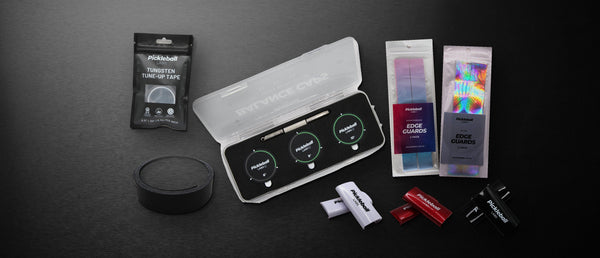
Add a net from our portable pickleball nets if you have a flat surface and no marked court, and you own a game rather than renting one. Free AU shipping over $150, excluding bulky items such as nets and ball machines.
Coming from padel? Handle length is the spec that matters
If you have been playing padel and you are buying a pickleball paddle, almost all the advice you will read online is about weight and face material. For you, specifically, it is the handle.
Padel players hit a lot of two-handed backhands. That habit does transfer, and it needs room on the handle. So the spec to check first is handle length, and the spread across our range is bigger than people expect.
| Paddle | Price | Handle length | Grip circumference | Swing weight | Twist weight | Core |
|---|---|---|---|---|---|---|
| Six Zero Quartz | $99 | 5.0 in | 4.25 in | 108 | 6.4 | 15 mm honeycomb |
| Six Zero Sapphire | $149.99 | 5.6 in | 4.25 in | 112 | 5.68 | 13 mm honeycomb |
| Six Zero Coral Pro 16mm | $300 | 5.5 in | 4.125 in | 110 to 117 by shape | not published | 16 mm foam |
| Honolulu J2CR, regular handle | $308 | 5.5 in | 4.125 in | 110 to 114 | 7.0 | 16 mm foam |
| Honolulu J2CR, extended handle | $308 | 6.0 in | 4.125 in | 110 to 114 | 7.0 | 16 mm foam |
Read the two Honolulus together, because they are the clean test. The J2CR extended handle and the J2CR regular handle are the same paddle at the same $308, same face, same 16 mm foam core, same 4.125 in grip circumference. The only difference is 5.5 inches of handle against 6.0. For a two-handed backhand that half inch is the entire decision, and it costs nothing either way. Our J2CR review covers how it plays.
Now the part that argues against our own entry price. Handle length across that table spans a full inch, 5.0 to 6.0, while grip circumference spans 4.125 to 4.25 inches, about three millimetres. So circumference is close to a non-decision and handle length is a real one. The $99 Quartz has the shortest handle on the list, and if you hit two-handed off the backhand you will run out of room on it. Buy it for its face and its price, not for a two-hander. The same conclusion, from different paddles, is in how to hold a pickleball paddle.
If you already generate heavy spin, which most padel players do, the Six Zero Coral Pro 16mm at $300 is the one we would hand you, on a measured 2,481 rpm off its Diamond Grit face. Browse the rest in pickleball paddles, or start with beginner pickleball paddles and pickleball sets if this is a first paddle. If you would rather not choose, the paddle finder does it in four questions.
Pickld carries the brands featured here. Picks are based on customer order data and product specs, not affiliate incentives.
What we do not sell
We do not sell padel gear. No rackets, no padel balls, and we have no plans to. If you land on padel after reading this, buy from a padel specialist.
We also do not sell shoes, for either sport, which matters because the court shoe question is the most-searched gear question next to the paddle itself. Padel and pickleball both ask for lateral support rather than a running shoe, and both reward a non-marking sole indoors. That is as far as we will go, because we do not stock them and we are not about to pretend otherwise. What we do stock around the paddle is in pickleball paddle accessories and the balls are in pickleball balls.
Where to play each one in Australia
Pickleball is the easier one to find. Clubs run sessions on existing hard courts in most capitals and a lot of regional towns, and pickleball courts in Australia is our running list of where to look. Pickleball Australia is the national body.
Padel is venue-led, so availability depends entirely on whether somebody has built a court near you. Courts are going in quickly, and the honest answer is that the map changes month to month, so a list here would be out of date before you read it. Search for a padel venue in your city rather than trusting any directory, including ours.
Common questions
Is padel the same as pickleball? No. They share a stringless solid bat and an underarm serve, and almost nothing else. Different court, different size, different scoring, and only one of them has walls in play.
Which is easier, pickleball or padel? Padel is easier to rally on day one because the walls keep the ball in. Pickleball is easier to get started in, because you do not need a built court and the rules are shorter.
What is the origin of padel? Mexico, 1969. Pickleball came first, in Washington in 1965, which catches most people out.
Can you play padel singles? Rarely. The court is built for four, and LTA Padel notes that the speed and the size of the court make singles play difficult. Pickleball plays singles on exactly the same court as doubles.
Is a padel racket the same as a pickleball paddle? Both are solid and stringless. A padel racket is thicker and perforated with holes through the face; a pickleball paddle is a thin rigid panel with a honeycomb or foam core and no holes through it. They are not interchangeable, and neither is legal in the other sport.
So which one
If you want the most pickleball for the least friction, that is the one we sell and the one you can play this week: a court near you, a paddle you own, and 11 points. If you want the glass box and the tennis scoreline, padel is a genuinely great sport and it will cost you a booking every time.
What we would not do is treat them as rivals. The clubs doing best out of this are the ones that put a padel court in and kept marking pickleball lines on the hard courts, because the two sports pull in slightly different people. If you are new to ours, start with pickleball for beginners in Australia, or the rules if you just want to know how a game works. And if you came here from tennis rather than padel, pickleball vs tennis is the other half of this question.
Questions about any of it, just hit reply or email us. We answer our own.
Ben