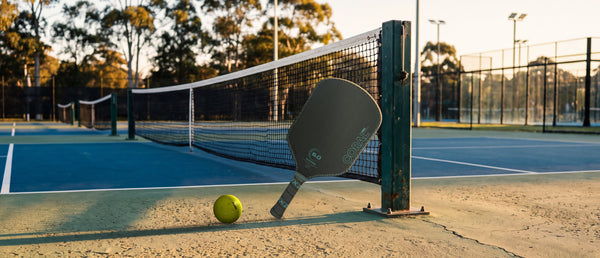
To add weight to a pickleball paddle, stick tungsten or lead tape to the rim, clip small weights over the edge, or fit a weighted cap to the end of the handle. Tape and clips on the head add power and stability; weight in the handle moves the balance point back towards your hand so the paddle feels steadier without swinging much slower. Change one spot at a time, keep both sides matched, and play a few sessions before you decide.
Paddle weight is the number everyone quotes, but it is a blunt one. Two paddles can both weigh the same on a scale and feel completely different in the hand, because where the weight sits matters as much as how much there is. That is the whole idea behind tuning: instead of buying another paddle to chase a feel, you move a few grams to where you want them and find out what your current paddle should have weighed all along.
This guide covers every way to do it with products we stock in Australia: tungsten tape, lead tape, weighted clips and balance caps. If you are after the wider kit (grips, overgrips, covers and the rest), start with our paddle accessories explainer. This article is the one for weight and balance.
Paddle weight, swing weight and balance point, in plain English
Three ideas are worth separating, because tuning moves them by different amounts.
- Static weight is what the paddle weighs on a kitchen scale. Add 3 grams anywhere and it goes up by 3 grams. That is all this number can tell you.
- Balance point is where the paddle would balance on your finger. Weight near the head pulls it towards the head (a head-heavy paddle); weight near the handle pulls it back towards your hand (head-light).
- Swing weight is how heavy the paddle feels when you swing it. It depends on how far the mass sits from your hand, so a gram at the tip of the paddle adds far more swing weight than a gram at the butt of the handle. A gram in the handle can leave swing weight barely changed.
That is the lever behind every tuning decision. Mass out on the head makes the paddle plough through the ball and resist twisting on off-centre hits, at the cost of a slower, heavier feel at the kitchen line. Mass in the handle makes the paddle feel steadier and more solid without the same slowdown. Most good setups use a little of both.
Manufacturers publish static weight and sometimes swing weight, but the only number that really counts is whether the paddle feels right in your hand, on your shots. If you are shopping for a paddle first and tuning second, our paddle buying guide is the better starting point.
Where to add weight, and what each spot does
Here is the cheat sheet. The effect column describes the direction of the change, not a guaranteed result: every paddle and every player is a little different.
| Where | What it tends to do | Best tool |
|---|---|---|
| Top edge of the head (12 o'clock) | Adds power and depth. Biggest increase in swing weight, so the paddle feels heavier through the ball and slower to bring up at the net. | Tungsten tape in short pieces |
| Sidewalls (3 and 9 o'clock) | Adds stability and balance. Less twisting on off-centre hits. A sensible first place to try. | Weighted clips, or tape in matched pieces |
| Bottom corners of the head | Puts mass low on the face, so it is steadier near the throat and adds less swing weight than the top edge. | Tungsten tape |
| End of the handle | Moves the balance point back towards your hand. Heavier and steadier, with little change to swing weight. Tames a head-heavy paddle and counterbalances tape on the head. | Balance caps |

The top-edge, sidewall and bottom-corner guidance matches the application guide printed on the back of our tape pack. The handle guidance is why the balance caps exist.
Tungsten tape vs lead tape
Both do the same job: a thin, self-adhesive strip of dense metal that adds weight exactly where you stick it. The difference is the metal.
Pickleball Labs Tungsten Tune-Up Tape is tungsten, and the pack states it is non-toxic. That matters more than it sounds: you handle a paddle every few seconds for an hour, you wrap your hand around the handle, and tape sits right where your fingers and the ball go. Some players simply prefer not to have lead on a paddle they are touching all session. The roll is 0.5 inch wide and 30 inches long at 0.5 grams per inch, so you cut it to the gram rather than working in fixed strips. One inch is 0.5 g, and a full roll works out to 15 g.
Lead tape is the traditional answer, and it is perfectly effective. We stock lead tape strips if that is what you already use, and it does the same job. Our own preference is tungsten for anything that lives on a paddle full time, but it is a preference, not a rule.
Whichever you choose, the technique is identical: cut a piece, press it down firmly on a clean, dry edge, smooth it flat and avoid wrapping it so it catches on your grip or the net. Check the tape sits flat before you play.
Weighted clips: the tidy way to add 3 grams to the edge
Pickleball Labs Weighted Clips are 3 gram clips that wrap over the paddle rim, sold as a pair so you can keep the paddle balanced with one on each side. They come in white, red, black, blue and silver with a gloss finish and the Pickleball Labs wordmark, so they double as a bit of colour on the edge.
They are the simplest tuning step because you do not have to measure or cut anything. The usual order of play is sides first (3 and 9 o'clock) for stability and fewer twists on off-centre hits, then higher up the sides if you want more power and are happy with a heavier feel at the kitchen line. A pair is 6 g in total, which is a meaningful change on most paddles, so do not stack them up on day one.

Balance caps: weight at the handle
Tape and clips live on the head. Pickleball Labs Balance Caps work at the opposite end. Each one is a weighted disc that sticks onto the butt cap your paddle already has, and the set comes in a clear case with three sizes: 6 g, 9 g and 12 g.
Why add weight to the handle? Three reasons come up again and again:
- Tame a head-heavy paddle. If a paddle feels sluggish at the kitchen line, weight at the butt pulls the balance back towards your hand and makes the head feel lighter to move.
- Counterbalance tape on the head. If you have added weight to the top or sides and the paddle now feels too far forward, a cap brings it back without giving up the extra mass.
- Add steadiness. More total weight, with only a small change to swing weight, is a calm, solid feel that suits blocks, resets and dinking.
Supply is limited on the caps at the moment, so if they are what you are after, check stock on the product page before you plan around them.
How much weight to add, and how to test it
The mistake almost everyone makes is adding too much, too fast. A few grams is a big change in feel, and it is very easy to overshoot into a paddle that is heavy, slow and tiring on the arm and shoulder.
- Play the paddle stock first. You cannot judge a change without a baseline. Note what you want to fix: not enough power on drives, twisting on off-centre hits, or a nose-heavy feel at the net.
- Change one thing at a time. One spot, one amount. If you add tape and a cap together you will never know which did what.
- Start small. With tungsten tape, a one inch piece is half a gram. Try an inch on each side, or one clip on each side, before going further.
- Keep it symmetrical. Match the left and right sides. An uneven paddle twists in the hand and is hard to trust.
- Play at least a few sessions. Hit dinks, drives, volleys and resets. First impressions on a few warm-up balls are unreliable.
- Add or remove in small steps. If it helped, try a little more. If it felt worse, take the change off and try a different spot.
As a general guide, power players tend to add towards the top and sides of the head, control and kitchen players tend to favour the sidewalls or the handle, and anyone with a sore arm should be cautious about adding mass at all. If your paddle already feels heavy, the better fix is often to move weight, not add it: a little in the handle and none on the head.
If you would like to try all three methods without buying them one by one, the Pickleball Labs Tuning Kit combines the tungsten tape, a pair of weighted clips and the balance caps, and it works out cheaper than buying the three separately. The Ultimate Paddle Kit goes further and adds a cover, an edge guard pack and an overgrip, with colours picked by you.

Tournament rules: check before you tune
If you only play social and club games, tune away. If you play sanctioned events, check first. USA Pickleball allows edge guard tape and weighting tape within placement limits. Handle weights and clip-on weights are not clearly on its permitted list, so we do not claim any of these products is tournament legal or approved. Read the current equipment rules for your event, or ask the tournament director, before you take a tuned paddle onto court.
Edge guard first, then tune
One practical order of operations: protect the rim, then tune it. The Pickleball Labs Edge Guard 2-Pack is self-adhesive rim tape that takes the chips and scrapes from low dinks and ground contact. It comes in Clear, Pink, Carbon Black, and the new Ocean Blossom and Silver finishes. It protects the rim the hits would otherwise reach.
For a brand new paddle, the New Paddle Pack pairs an edge guard 2-pack with FlexTac overgrips, which is the sensible first step before any tuning at all. You can browse the whole range in the Pickleball Labs collection or the wider paddle accessories collection. For a broader look at protecting, training and carrying, see our Pickleball Labs accessories guide.
Frequently asked questions
How much weight should I add to a pickleball paddle?
Start with a gram or two in total and build up slowly. A one inch piece of our tungsten tape is half a gram, and a pair of clips is 6 g. A few grams is already a noticeable change, and too much can make a paddle tiring to swing.
Where is the best place to put lead tape or tungsten tape on a paddle?
It depends on the job. The top edge adds power and depth, the sidewalls add stability, and the bottom corners put mass low on the face for a steadier feel with less swing weight than the top edge. If you are unsure, start on the sides, matched left and right.
What is the difference between lead tape and tungsten tape?
They do the same job. Lead tape is the traditional choice. Tungsten tape is a denser metal that is not lead, and ours is labelled non-toxic on the pack, which some players prefer for something they handle all session.
Does adding weight make a pickleball paddle more powerful?
Extra mass in the head, particularly the top edge, generally adds power and plough-through, at the cost of a heavier feel and slower hands at the net. Weight in the handle changes the balance more than the power.
Will weight at the handle slow my swing down?
Much less than the same weight on the head. Handle weight moves the balance point towards your hand and adds steadiness, with only a small change to swing weight, which is why it is the usual fix for a head-heavy paddle.
Is it legal to add weight to my paddle for tournaments?
USA Pickleball allows weighting tape and edge guard tape within placement limits. Handle weights and clip-on weights are not clearly on its permitted list, so check the current rules or ask the tournament director before a sanctioned event.