The pickleball kitchen rules trip up more players than any other part of the game. The kitchen is not a mystery once you see it clearly: it is the non-volley zone, the box closest to the net, and the whole rule is basically one sentence. You cannot hit the ball out of the air while you are standing in it. Everything else is detail. Here is the non-volley zone explained the way we would explain it courtside, plus the faults people actually give away points on.
What is the kitchen in pickleball?
The kitchen is the official non-volley zone: the area that runs 2.13 metres (7 feet) back from the net on each side, stretching the full width of the court. Its proper name is the non-volley zone, or NVZ. "Kitchen" is just the nickname everyone uses.
The lines that mark the kitchen are part of the kitchen. That matters, because touching the line counts as touching the zone. If you want the exact court measurements, we lay them out in our pickleball net height and court dimensions guide.
The pickleball kitchen rules, in plain English
- No volleying in the kitchen. You cannot hit the ball out of the air (a volley) while any part of you is touching the kitchen or its lines.
- The lines are in. Toe on the line while you volley is a fault, the same as standing well inside.
- Momentum counts. If the act of volleying carries you into the kitchen, it is a fault, even after the ball is dead and even if you land there a second later.
- Anything you are wearing or carrying counts. If your hat, sunglasses or a dropped paddle lands in the kitchen as a result of your volley, that is a fault too.
- You can stand in the kitchen any time the ball has bounced. Stepping in to play a dink off a bounce is completely legal. The zone only stops you volleying, not standing there.
- Reset before you volley again. After being in the kitchen you must get both feet fully back out before your next volley is legal.
- The serve must clear it. A serve that lands in the kitchen, including on the line, is a fault.
The kitchen rules people break most
Almost every kitchen fault is one of three things. First, the momentum fault: you put away a high ball at the net, and your follow-through drags a foot over the line. The point was won, then handed straight back. Slow the swing and stop your feet.
Second, the toe-on-the-line volley during a fast hands battle at the net. In doubles this happens constantly because nobody is watching their own feet. Third, the volley-then-step: hitting the ball out of the air and then stepping into the kitchen in the same motion. If the two are part of one action, it is a fault.
In doubles, one more thing to know: your partner is allowed to stand in the kitchen. The fault only lands on the player who actually volleys and touches the zone, so do not call your partner out just for being in there.
Can you ever step into the kitchen?
Yes, and good players do it all the time. The moment the ball bounces, the kitchen is fair game. A dink that drops short pulls you in, you let it bounce, and you play it from inside the zone. That is legal. The instant you want to volley again, get both feet back behind the line first. Think of it as a doorway you can walk through freely, as long as you are not carrying a live volley when you cross it.
How to actually play the kitchen line
Winning at the kitchen is a dinking game: soft, controlled shots that stay low over the net and land in your opponent's non-volley zone. The skill that gets you there from the baseline is the third shot drop, and once you are at the line it becomes patience, placement and control rather than power.
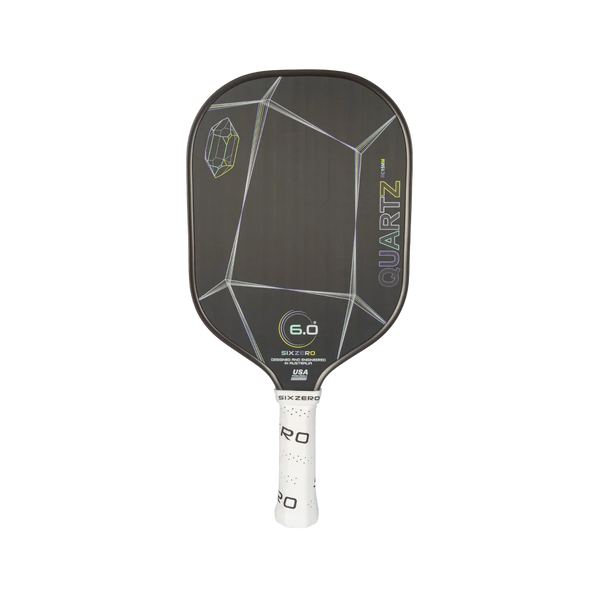
Gear helps here more than people expect. A control-leaning paddle with a soft, grippy face makes dinks easier to land and gives you more margin at the line than a raw power bat. If you are still building your kitchen game, an entry control paddle like the Six Zero Quartz (a $99 carbon, all-court paddle, and one we have reviewed in full) does the job without the top-shelf price. The Friday Fever 102 Gen 3 at $175 is a step up with a Toray T700 carbon face if you want more bite on your dinks and rolls. Browse the rest of our control pickleball paddles, or if you are just starting out, the starter paddle range. Free AU shipping over $150.
Pickleball kitchen rules FAQ
Can you hit the ball in the kitchen? Yes, as long as it has bounced. You just cannot volley (hit it out of the air) while standing in the zone.
Is the kitchen line in or out? In. The lines are part of the non-volley zone, so a foot on the line while volleying is a fault.
How big is the kitchen? 2.13 m (7 feet) from the net on each side, across the full 20-foot court width.
Can my partner stand in the kitchen? Yes. Only the player who volleys and contacts the zone commits the fault.
What happens if my momentum carries me in after a volley? It is a fault, even if the ball is already dead. The volley and the step are treated as one motion.
New to the game? Start with our pickleball for beginners guide, and for scoring, serving and the full picture see our complete pickleball rules and scoring guide. The official word lives in the USA Pickleball rulebook.