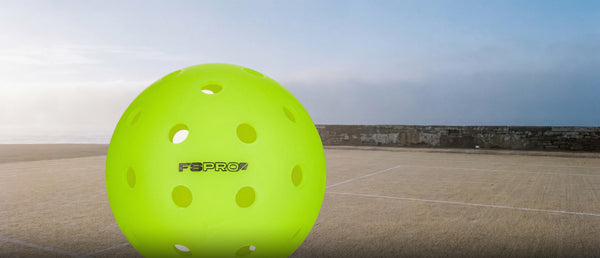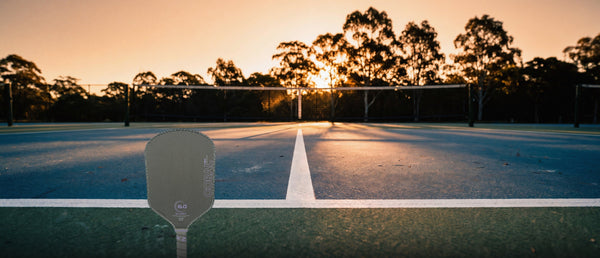


Almost everyone who turns up to their first session has played something with a racket before, and the pickleball vs badminton question is the one we get asked most often at the counter. Squash and table tennis players ask the same thing in different words: how much of what I already have actually transfers? The honest answer is that every one of the three gives you a real head start, and every one of them hands you a specific bad habit that will cost you points for a month.
Here is what carries over from each, what to unlearn, and which paddle suits you once you have decided to keep playing.
The quick version
| You come from | Biggest advantage | Biggest habit to unlearn |
|---|---|---|
| Badminton | Hand speed and reflexes at the net | Flicking everything with the wrist |
| Squash | Court fitness and reading an opponent | A long, wristy swing with no reset shot |
| Table tennis | Spin, instantly | Standing too close and swinging too small |
| Tennis | Groundstrokes and serve placement | Hitting hard when soft wins the point |
Tennis gets its own piece, because the overlap is the biggest and the traps are different: read pickleball vs tennis for Australian players. If you are weighing up the other new sport on everyone's lips, we have also compared padel and pickleball on court, rules, cost and gear.
Pickleball vs badminton: the same court, a very different ball
This is the closest pairing of the three, and it starts with the ground under your feet. A pickleball court is 13.41 m by 6.10 m, which is the same footprint as a doubles badminton court. Plenty of Australian clubs run their pickleball sessions on badminton lines in the same hall for exactly that reason.
After that the two sports separate fast. The badminton net sits at about 1.52 m in the middle. A pickleball net sits at 0.91 m at the posts and 0.86 m in the centre, so the ball travels through the space you are used to playing over. A shuttle also decelerates hard after you hit it, which is what makes a badminton smash safe from almost anywhere. A pickleball ball does not decelerate like that. Smash from the baseline and you are mostly gift wrapping a counter.
What transfers brilliantly is your hands. Badminton players arrive with the fastest reflexes of any convert, and the hands battle at the kitchen line is where that shows up within a fortnight. Scoring is also familiar in shape, if not in detail: badminton uses rally scoring to 21, while most social pickleball in Australia still uses side-out scoring to 11, where only the serving side can score. Our guide to keeping score in pickleball covers it properly.
The habit to unlearn is the wrist. Badminton rewards a snap at the last instant. Pickleball punishes it, because a wristy stroke on a heavier ball sprays the ball long and makes the soft game almost impossible. The fix is a firmer wrist and a shoulder-led stroke, and it starts with how you hold the paddle: see grips and grip size for pickleball.
Pickleball vs squash: the fitness transfers, the swing does not
Squash players are the fittest converts who walk in, and it is not close. A squash court is 9.75 m by 6.4 m with walls in play, so you arrive already able to cover ground, change direction and read where someone is about to hit. On a doubles pickleball court that is a genuine edge, especially in the third game of a long session.
The problem is the swing. A squash stroke is long, open faced and heavily wristed, and it is built to drive a ball into a wall. Nothing on a pickleball court wants that. There is no back wall to retrieve from, the ball is in play for far fewer shots, and the point is usually decided softly at the net rather than hard at the back.
Two specific things to work on. First, the reset: a squash player's instinct under pressure is to hit harder, where a pickleball player's is to take pace off and land the ball in the non-volley zone. Second, the kitchen itself, which has no equivalent in squash at all and is the rule most new players get wrong. Start with the non-volley zone explained, then learn the dink, which is the shot that will feel most foreign and matter most.
Pickleball vs table tennis: the best spin head start in the game
Table tennis converts get the single most valuable transfer of the three. The brushing topspin stroke, the loose grip, the compact contact and the feel for what spin does off a bat all carry straight across. On a modern raw carbon face, a player who already knows how to brush a ball generates serious spin from day one, while most beginners spend six months learning that the paddle face is not a wall.
Scoring will feel familiar too, since table tennis plays rally scoring to 11. The differences are physical. A table is 2.74 m by 1.525 m and you play it from a metre away; a pickleball court is five times longer and you have to cover it on your feet. The swing has to get bigger for a serve and a drive, and the ready position has to get lower.
The habit to unlearn is standing too close to whatever is in front of you. On a table that is correct. On a court it leaves you stranded in the transition zone, which is the worst place to be. Move through it to the kitchen line and stop there.
Which paddle suits a racket-sport convert
Three numbers decide how a paddle feels to someone with existing racket skills: swing weight (how heavy it feels to swing, not on the scales), twist weight (how forgiving it is off centre) and handle length (whether a two-handed backhand fits). Every figure below is from the paddle's own spec sheet.
From badminton: lowest swing weight you can find
You already have the hands. Protect them with a paddle that moves fast and forgives a mishit. The Six Zero Quartz at $99 is 224 g with a swing weight of 108 and a twist weight of 6.4, which is the lightest swinging and most forgiving combination we stock at that price. It is a 15 mm widebody on a T300 raw carbon face, with a 5.0 in handle. If you want to find out whether pickleball sticks before spending properly, this is the one.
From squash: a longer handle and room for a full swing
You will want reach and a paddle that tolerates a bigger cut at the ball. The Luzz Cannon at $155 is an elongated 16 mm paddle, 224 g, with a 5.5 in handle and a swing weight of 119. That higher swing weight is the point: it rewards a committed stroke rather than a flick, and the T700 raw carbon friction face holds spin when you do finally shorten up.
From table tennis: buy the grit
Your spin is already there, so give it a face worth using. The Six Zero Coral Pro 16mm at $300 measures 2,481 RPM on its Diamond Grit face, the highest spin figure in our range, and it comes in widebody, hybrid and elongated with swing weights of 110, 114 and 117, so you can pick how much mass you want behind the stroke. If $300 is more than you want to spend on sport number two, the Six Zero Sapphire at $149.99 reads 2,175 RPM on a Toray 700K face, in a 13 mm elongated build with the longest handle of the four at 5.6 in, which also suits a two-handed backhand.
If none of those is quite you, the full range is on the pickleball paddles page, and the entry tier is grouped under beginner pickleball paddles. Weight is the spec people get wrong most often, so it is worth reading how heavy your paddle should be before you commit. Free AU shipping over $150.
Common questions
Is pickleball easier than badminton?
It is easier to start and no easier to master. The lower net, the slower ball and the underarm serve mean a complete beginner rallies in minutes, where badminton takes weeks. The kitchen rule, the soft game and side-out scoring take just as long to get good at as anything in badminton does.
Can you play pickleball on a badminton court?
Yes, and the court is the right size, but the net is not: badminton posts hold the net roughly 0.6 m too high. Most halls either drop a portable pickleball net over the top or run both sports in different sessions.
Which sport transfers best to pickleball?
For hands and reflexes, badminton. For spin, table tennis. For fitness and court reading, squash. For raw shot-making, tennis. None of them transfers the soft game, which is why a strong racket-sport player can beat a beginner comfortably and still lose to a club player who only dinks.
Do I need a different grip size coming from another racket sport?
Usually yes, and usually smaller. Pickleball grips run narrower than tennis or squash, and the paddles above sit between 4.125 in and 4.25 in. A grip that is too big slows your hands and blunts your spin.
Pickld carries the brands featured here. Picks are based on customer order data and the products' own specs, not affiliate incentives. Prices and stock were correct on 23 October 2026.
Come from one of these sports and found something that surprised you? Hit reply and tell us, we are collecting them.
Chris