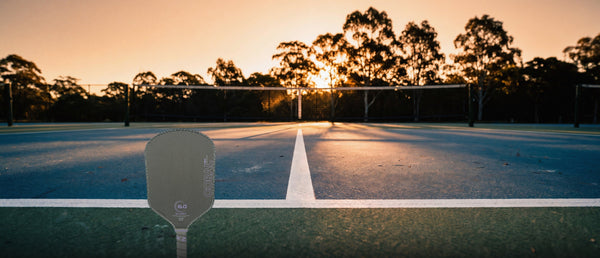


Short answer: if you spend any real time at the kitchen line, pickleball glasses are the cheapest insurance in the sport. Nobody is going to stop you at the gate for playing without them, and most of the social games you turn up to in Australia will have one person in eyewear and seven without. That is a habit, not a verdict on the risk. The mechanics of this sport put a hard plastic ball at head height, hit flat, from about four metres away, and the front of your eye has no bone in front of it.
This is not a sales page. It is the explanation we give people at the warehouse when they ask, and the honest version of what to look for. Pickld carries the brands named below. Nothing here is ranked for an incentive: the ball comparison is there because the ball is the thing that hits you.
Why the kitchen line is where eyes get hit
The non-volley zone sits seven feet, or 2.13 metres, back from the net on each side. When both teams are up, two players at opposite kitchen lines are about 4.3 metres apart. That is closer than the service line on a tennis court and closer than most people picture when they think about a paddle sport.
It is not the speed on its own that makes that distance matter. It is reaction time. In a hands battle the ball changes direction off a paddle face you cannot read, at chest and head height, with no backswing to telegraph it. You have no time to turn your head. Tennis gives you a long ball flight and a visible swing. The kitchen gives you neither, which is exactly what makes a hands battle fun and exactly why the eye is exposed.
The other common one is nothing to do with your opponent. It is your partner's paddle, or your partner's ball, arriving from the side while you are watching the net. Anyone who has played mixed doubles in a tight court knows the feeling.
What actually hits you: the ball is harder than it looks
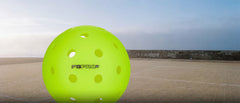
A pickleball is injection-moulded rigid plastic. It does not deform much on impact the way a tennis ball does, so it transfers what it has straight into whatever it meets. Outdoor balls are the hardest and heaviest of the lot, because they have to hold a true flight in wind. Indoor balls are softer and lighter. Foam practice balls are softer again.
Here is what that difference looks like across the pickleball balls we actually stock:
| Ball | Where it is used | Feel on impact | Price |
|---|---|---|---|
| Franklin X-40 outdoor pickleballs, 12 pack | Outdoor, the Australian tournament default | Hardest. This is the one that leaves a mark | $47.95 |
| Franklin FS Pro indoor pickleballs, 10 pack | Indoor halls and courts | Softer and lighter, larger holes | $40.95 |
| Pickleball Labs Silent Pickleball | Indoor practice, quiet halls, drills at home | Foam. The lowest-risk ball we sell | From $8.00 |
If you want the full comparison of how the two ball types behave, we wrote that up separately in indoor versus outdoor pickleballs. The short version for this page: outdoor play is the higher-risk setting, and outdoor play is most of what happens in Australia.
Sunglasses are not eye protection
This is the one worth being blunt about. Fashion sunglasses are built to survive being sat on in a car, not to stop a projectile. Many have glass or thin acrylic lenses, and under a direct hit the failure mode is the lens coming into the eye rather than keeping something out of it. A pair of sunglasses can make your afternoon more comfortable in Australian glare and do nothing at all for the risk this page is about.
Protective eyewear is a different object. The lens is a single piece of polycarbonate, the frame is designed to hold it in place under impact, and the whole thing is tested as a unit. Sports sunglasses from a reputable brand are often made this way and are genuinely fine. Your everyday pair from a shopping centre almost certainly is not.
What to look for in pickleball glasses
- A polycarbonate lens, in one piece. No glass, no two-part lens, no frameless novelty.
- A standard marked on the frame or the packaging. In Australia that is usually AS/NZS 1337.1, the eye-protection standard. American racquet-sport eyewear is often marked ASTM F803. If nothing is marked anywhere, you are buying a look.
- Coverage that wraps. The shots that catch people come in from the side as often as the front. A flat lens leaves the corner of the eye open.
- Ventilation, because they will fog. A humid Sydney evening or an indoor hall will fog a sealed lens inside two games, and a pair you take off is a pair that does nothing.
- A fit that works with a cap. Most people play outdoors in a hat. If the arms fight the brim you will stop wearing them.
- Clear or light tint for indoors. A dark lens indoors costs you the ball. Keep the tinted pair for outdoors and have something clear for the hall.
- Prescription, if you wear glasses. Playing in your everyday frames is the worst of both worlds. Either over-glasses that fit around them, or a prescription sports pair.
Who should definitely wear them
Everyone benefits, but some people should stop thinking about it and just get a pair. If you have had eye surgery, have sight in one eye only, or wear contact lenses, the downside of a hit is not the same as it is for everyone else. Juniors should wear them, full stop. And if you have moved past the baseline rallies and now live in the kitchen, your exposure has gone up, not down, as your game has improved. That is worth knowing: the better you get at closing to the net and winning hands battles, the more of these balls come at your face.
Clubs and venues are the other case. If you run sessions, a few spare pairs in the gear box costs very little and changes what a bad moment looks like. We put the rest of the gear-box thinking in our guide to starting a pickleball club.
What we stock, and what we do not
Full disclosure, because this page would be worth nothing without it: when this went up in October 2026, Pickld did not stock protective eyewear. There is nothing for us to sell you at the bottom of this article, and we are not going to pretend a paddle recommendation is a substitute for a lens. If that changes, we will say so here.
What we can help with is the rest of the kit bag. Balls, grips, covers and edge protection all live in pickleball paddle accessories, and free AU shipping starts at $150, so most people pick up balls alongside something bigger. The 100-pack bulk ball boxes are the exception: they are charged real freight because of their size rather than riding the threshold.
Common questions
Do I need pickleball glasses as a beginner?
Less than an advanced player does, which is the opposite of what most people assume. Beginners spend most of a rally behind the baseline hitting long, slow balls. The exposure arrives when you start living at the kitchen line. If you are just starting out, our guide to pickleball for beginners is the better first read.
Will pickleball goggles fog up?
Yes, if there is no ventilation. Look for vents in the frame or lens, keep an anti-fog cloth in the bag, and do not store them lens-down in a hot car, which wrecks the coating.
Can I just wear my normal glasses?
You can, and plenty of people do, but understand what you are wearing. Everyday lenses and frames are not impact-rated, and a hit that would have bounced off a sports lens can instead push your own frames into your face. Over-glasses or a prescription sports pair solve it properly.
Why do the pros play without them?
Habit and vision, mostly. At the top level, players trade a small amount of visual clarity for comfort and they are extremely good at getting a paddle in front of their face. That is a professional's calculation on a professional's reflexes, and it is not a recommendation for a Tuesday night social game.
If you take one thing from this: the risk in pickleball is not the sport being dangerous, it is the distance being shorter than it feels. Four and a bit metres, a hard ball, and no time to blink. A pair of rated glasses costs less than a set of balls and you forget they are on after two games.