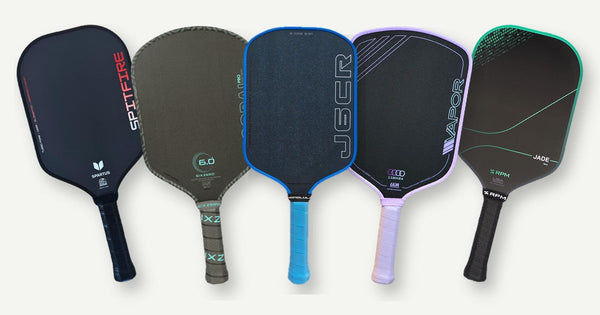
Pickleball paddle shape is the spec everyone argues about and almost nobody measures. Elongated, widebody, hybrid: the marketing says power, forgiveness, best of both, and you are left guessing which outline suits your game. So we pulled the real numbers off the paddles on our own shelf, including one paddle that comes in all three shapes at the same price, and the honest answer surprised us. Shape decides reach and forgiveness. It barely touches spin at all.
The short answer
- Elongated. Longest face, most reach, heaviest swing, smallest margin for error off centre. Singles, two-handed backhands, players who like to drive.
- Widebody. Widest face, biggest sweet spot, lightest swing. Doubles, fast hands at the kitchen, anyone still finding the middle of the paddle.
- Hybrid. The elongated outline trimmed back for width. Most players land here and stay.
If you want the reasoning and the measurements, keep reading. If you just want the shortcut, the paddle finder asks four questions and filters the full range of pickleball paddles by shape, thickness and play style.
What the three pickleball paddle shapes actually are
Every USAP-approved paddle has to fit inside a combined 24 inches of length plus width. That is a fixed budget, and shape is simply how a brand chooses to spend it. Longer face, narrower body. Wider body, shorter face. There is no free reach.
Measured off the paddles we stock:
| Shape | Typical face size | What you are buying | What you give up |
|---|---|---|---|
| Elongated | 41.9 x 19.1 cm (16.5 x 7.5 in) | Reach and leverage at the top of the face | Width, and stability on off-centre hits |
| Hybrid | 41.6 x 19.7 cm (16.4 x 7.8 in) | Most of the reach, most of the width | Nothing obvious, which is why it sells |
| Widebody | 40.6 x 20.3 cm (16.0 x 8.0 in) | The largest, most forgiving sweet spot | About 1.3 cm of reach |
The gap between the longest and the shortest is 1.3 cm. That is less than most players expect, and it is why shape arguments based on feel alone go nowhere.
One paddle, three shapes: the Friday Aura Pro test
The Friday Aura Pro is the cleanest test we can run, because Friday builds it in all three shapes with an identical dual-foam core, an identical T700 raw carbon face and the same 16 mm thickness, at the same $275. The outline is the only variable.
| Friday Aura Pro | Face size | Swing weight | Twist weight | Handle | Static weight | Spin (rpm) |
|---|---|---|---|---|---|---|
| Elongated | 41.9 x 19.1 cm | 116 | 6.0 | 5.5 in | 227 g | 2,295 |
| Hybrid | 41.6 x 19.7 cm | 116 | 6.35 | 5.5 in | 226 g | 2,290 |
| Widebody | 40.6 x 20.3 cm | 107 | 6.8 | 5.4 in | 223 g | 2,289 |
Read the last two columns first, because they are the ones that break the marketing.
Spin moves 6 rpm across the three shapes. On a figure of 2,290 that is 0.3%, which is inside measurement noise. Same face, same grit, same spin. If someone tells you an elongated paddle spins the ball more, they are describing their swing, not the paddle.
Twist weight moves 13%, from 6.0 on the elongated to 6.8 on the widebody. Twist weight is the one number that says how much the head resists rotating when you catch the ball away from the middle. Higher is more forgiving. The widebody is meaningfully more stable off centre than the elongated version of the same paddle, and that is the trade you are actually making.
Swing weight moves 8%, from 116 down to 107. The widebody feels quicker in the hand even though all three weigh within 4 grams of each other, because the mass sits closer to your hand.
Spin does not change. Forgiveness does.
This is the part worth carrying to the shop. Face material sets your spin ceiling, core thickness sets your control, static weight sets how heavy the paddle feels at the end of a long session, and shape sets reach and forgiveness. Those are four separate decisions, and mixing them up is how people end up with a paddle that fights them.
We have written the other three up separately: the face material guide covers what the grit is made of, the 14mm vs 16mm explainer covers core thickness, and the paddle weight guide covers static and swing weight. Shape is the fourth leg, and it is the one people over-think.
Which shape suits your game
Elongated
Pick elongated if you play singles, if you hit a two-handed backhand, or if your favourite shot is a drive from the baseline. The extra length gives you leverage on the serve and a genuinely longer reach on the stretch volley. It is the least forgiving of the three, so it rewards a player who already finds the middle of the face.
The RPM Q2 Elongated at $357.50 is the one we sell most of at this end: 41.9 x 19.1 cm, swing weight 114, twist weight 6.1. The footprint is identical to the Aura Pro Elongated, which tells you the elongated outline is close to standardised across brands.
Widebody
Pick widebody if you play doubles, if most of your points are decided at the kitchen, or if you are still learning where the middle of the paddle is. You get the biggest sweet spot and the fastest hands, and you give up a little over a centimetre of reach that most doubles points never ask for.
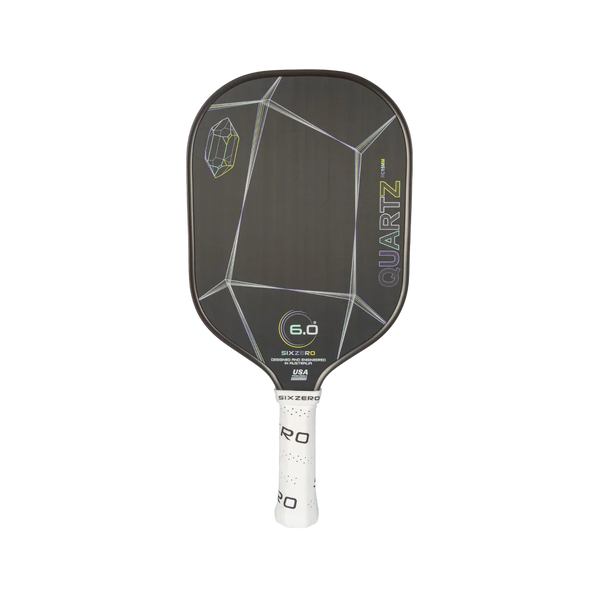
If you are starting out, the Six Zero Quartz at $99 is a widebody with a raw carbon face, a swing weight of 108 and a twist weight of 6.4. It sits in our beginner pickleball paddles range and it is the cheapest honest carbon paddle we stock.
Hybrid
Pick hybrid if none of the above described you, which will be most people. The hybrid keeps almost all of the elongated face length (41.6 cm against 41.9 cm) and claws back 0.6 cm of width, and in the Aura Pro data it lands almost exactly halfway on twist weight. It is not a compromise so much as the default, and the fact that it outsells both extremes on our store says players work that out quickly.
The Six Zero Coral Pro 16mm at $300 is worth knowing about here, because Six Zero sells one product in all three shapes and publishes the swing weight for each: widebody 110, hybrid 114, elongated 117. Different brand, different core, and the order comes out identical to the Friday test. It also measures 2,481 rpm, the highest spin figure in our Six Zero pickleball paddles range, which again has nothing to do with its shape and everything to do with its surface.
Handle length is the bit people miss
While you are looking at shape, look at the handle. Across the Aura Pro trio it moves from 5.5 in on the elongated and hybrid to 5.4 in on the widebody, and across the whole range we stock, handle length spans a full inch. That is a far bigger swing than grip circumference, which varies by about 9 mm across every paddle on the shelf.
If you hit a two-handed backhand, handle length is not a detail, it is the constraint. The clearest example we have is Honolulu, which sells the same paddle with two different handles, and we wrote that one up in the J2CR vs J6CR guide. The grip guide has the full measurements.
Does it hold up across the range?
Three independent checks, all from live stock:
- Friday Aura (the non-Pro, $215, full-foam EPP core): hybrid swing 110 and twist 6.0, widebody swing 107 and twist 6.6. Wider is more forgiving and quicker to swing.
- Six Zero Coral Pro: widebody 110, hybrid 114, elongated 117 on swing weight, published by the brand.
- RPM Q2 Elongated: 41.9 x 19.1 cm and swing weight 114, matching the elongated footprint exactly.
Three brands, three different cores, one pattern. Shape is a reach-versus-forgiveness dial, and every brand is turning the same dial.
How to pick yours without guessing
- Start with your format. Mostly doubles, start at widebody or hybrid. Singles or a lot of driving, start at elongated.
- Check the twist weight, not the marketing. Above about 6.5 is forgiving. Below about 6.1 asks you to be accurate.
- Then set thickness and face separately. Control-first players should also look at our control pickleball paddles; if you want to swing hard, start with the power pickleball paddles.
Free AU shipping over $150, and if you are between two shapes, hit reply on your order confirmation and tell us how you play. We would rather talk you into the right one than take the return.
Chris
Pickld carries the brands featured here. Picks are based on customer order data and published product specs, not affiliate incentives. Every measurement above is pulled live from the product records on this store on 28 September 2026, and specs can change between production runs.