For years, grit was what killed a pickleball paddle. The core often had plenty of life left, but the raw carbon face wore smooth within a few months, the topspin went with it, and you bought a new paddle. That is the problem durable grit pickleball paddles are built to solve, and it is the reason the hype right now is all about one combination: a foam core, which resists breaking down, paired with a durable grit face that keeps its bite. Put the two together and a paddle can last a lot longer than one season.
This guide covers the five we think matter most in Australia right now: the Honolulu J6CR Crystal Blue, the Six Zero Coral Pro, the 11SIX24 Vapor Power 2, the Spartus Spitfire and the RPM Jade. For each one we explain how the grit is actually made, and what the independent wear tests say about how long it lasts.
The short answer, before the detail: on every independent test we could find, all five sit in the top durability tier. The gap between them is a few percentage points. The gap between any of them and a standard raw carbon face is far bigger. So the honest way to choose is on shape, feel, price and the rules you play under, not on a grit number.
We have played four of the five ourselves, everything except the Jade, and we love all of them. Any of the four would go straight into our own bags. The Jade is the one we have not hit yet, because our stock is still on its way.
Quick picks.
- Best-measured grit retention: 11SIX24 Vapor Power 2 (HexGrit), $309.
- Best all-rounder you can have this week: Honolulu J6CR Crystal Blue, $308.
- Most texture for your money, widest shape choice: Six Zero Coral Pro, $300, in hybrid, widebody and elongated.
- Best value, and USAP approved: Spartus Spitfire, $170. Tier 1 grit at a little over half the price of the rest. Pre-order.
- Durable grit from RPM, USAP registered: RPM Jade, $374, with a full-foam core and four builds. Pre-order, shipping early October.
What "durable grit" actually means
Spin comes from friction between the face and the ball. On a traditional raw carbon or peel-ply face, that friction comes from a texture pressed into the cured resin. The problem is that a pickleball is harder than that resin. Every hit knocks a little off the peaks, and over a few months of regular play the face goes smooth.
That is measurable. John Kew's ball cannon wear test puts typical raw carbon at around 22.7% spin loss, which he rates Tier 4. Pickleball Effect's profilometer testing found raw carbon faces keep only about 81% of their surface roughness after controlled wear.
A durable grit paddle uses something harder than the resin to make the texture, so the ball cannot grind it away as fast. How the manufacturer does that is the whole story, and it is where the five paddles in this guide differ.
The levels of grit, from least to most durable
There are four broad ways to put texture on a paddle face. Think of them as levels. The construction tells you why a face should last. The wear tests further down tell you whether it does.
Level 1: raw carbon and peel-ply texture
The texture is the carbon weave and the resin itself, shaped by a peel-ply sheet during pressing. Brilliant spin when new, and the most common face in pickleball. It is also the one that wears smooth, because nothing in it is harder than the ball. Most RPM paddles outside the Jade, including the Q2 and Friction Pro V2, use RPM's CarbonBite raw carbon face.
Level 2: sprayed-on grit coatings
A textured coating applied on top of the finished face. It can start very rough. How long it lasts depends on how well the coating bonds to what is underneath, because once it chips there is only raw carbon below it.
Level 3: hard particles infused into the peel-ply resin
Here the grit particles are mixed into the resin layer that forms the texture, so the peaks are reinforced from the inside. Six Zero's Diamond Tough surface on the Coral and Coral Pro works this way. According to reviewers, the Coral Pro carries about twice the diamond dust of the original Coral, with larger particles.
Level 4: hard particles embedded before the face is pressed
The grit is locked into the epoxy before pressing. As the surface wears, fresh hard particles are exposed rather than a smooth layer. Four of our five paddles use a version of this:
- RPM SICmatrix (RPM Jade): silicon carbide, which RPM calls one of the hardest materials available, mixed into the epoxy.
- 11SIX24 HexGrit (Vapor Power 2) and Spartus PermaGrit (Spitfire): Pickleball Effect groups these as "ceramic hybrid" surfaces, where ceramic particles harder than peel-ply resin do the work.
- Honolulu Crystal Blue (J6CR, J2CR, J3CR): Honolulu describes a patent-pending process where blue crystal media is mechanically interlocked with the carbon face. Honolulu also says the texture is deliberately uneven, so a slightly patchy look is normal, not a fault.
How long does the grit last? The test numbers side by side
Three independent testers publish durable grit data. They use different methods, so compare within a column, not across the whole table. We have linked every source so you can check the numbers yourself.
| Paddle | Surface | Price (AUD) | Measured spin | Wear test result | Approval |
|---|---|---|---|---|---|
| 11SIX24 Vapor Power 2 | HexGrit | $309 | 2,113 RPM (Pickleball Effect) | 98% of roughness (Ra) kept, the best Pickleball Effect has recorded; 2,141 to 2,071 RPM after 100 games of wear (Pickleball Studio) | UPA-A |
| Honolulu J6CR Crystal Blue | Crystal Blue | $308 | 2,120 RPM (Pickleball Effect) | 97% of Ra and 92% of Rz kept, Tier 1 (Pickleball Effect) | UPA-A |
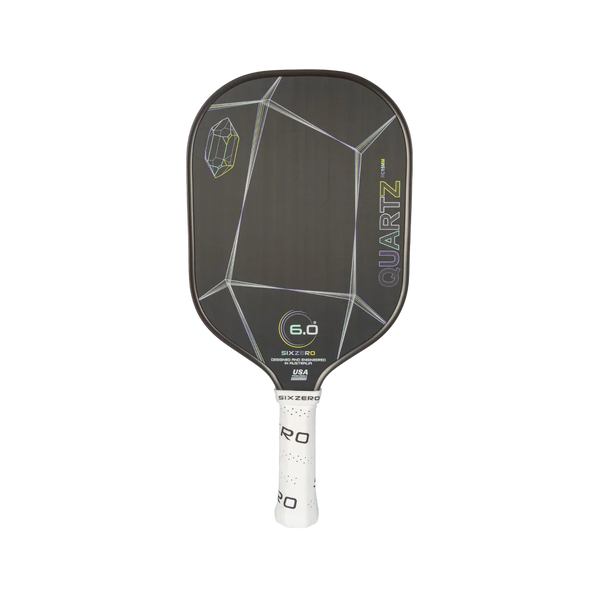
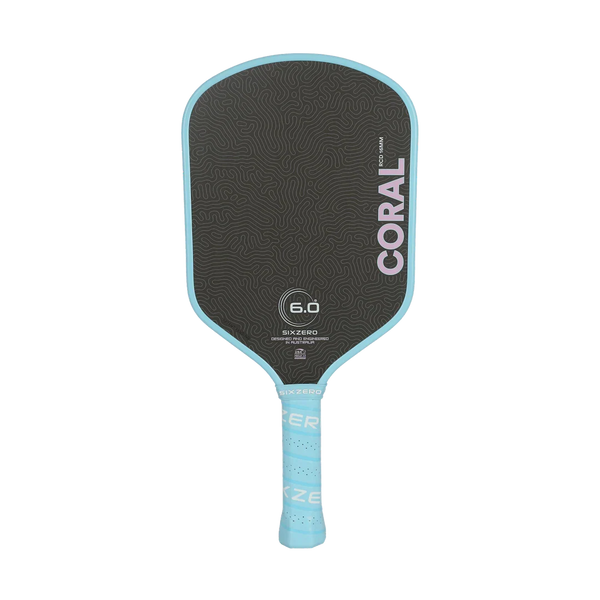
| Six Zero Coral Pro | Diamond Tough | $300 | Six Zero quotes 2,481 RPM; no independent figure yet | No measurable spin loss after 100 impacts in one spot, Tier 1 (John Kew) | UPA-A |
| Spartus Spitfire | PermaGritNano | $170 | 2,132 RPM (Pickleball Effect) | 94% of Ra and 97% of Rz kept, Tier 1 (Pickleball Effect) | USAP approved |
| RPM Jade | SICmatrix | $374 | Not yet published | Held its spin over a doubled 200-shot wear run, Tier 1 (John Kew, via pickleball.com) | USAP registered; UPA-A pending |
Sources: Pickleball Effect J6CR data, Pickleball Effect 11SIX24 Power 2 review, Pickleball Studio Vapor Power 2 review, John Kew Coral Pro review, Pickleball Effect Spitfire data, pickleball.com on the RPM Jade.
For context, Pickleball Studio saw that Vapor Power 2 lose about 70 RPM over its wear run, where a raw carbon face loses nearly 300 RPM in the same test. That is the practical difference durable grit makes, and all five of these paddles are on the right side of it.
11SIX24 Vapor Power 2: the best-measured grit
If you want the paddle with the strongest wear data behind it, this is it. HexGrit kept 98% of its roughness in Pickleball Effect's test, the highest they have recorded, and it lost the least spin in Pickleball Studio's run. John Kew also rates HexGrit Tier 1. Three testers, three methods, the same answer.
Underneath is a 16mm Gen 4 foam core in a 16.25 by 7.75 inch shape with a 5.75 inch handle. At a swing weight of about 114 and a twist weight of 6.86, it is a stable, powerful paddle that still gets to the kitchen line in time. 11SIX24 quotes 2,335 RPM for spin; the independent figure is 2,113, which is still well into high-spin territory.
Buy it if grit longevity is the single thing you care most about and you like a slightly longer face. Skip it if you need a USA Pickleball approved paddle (see the rules section below), or if you want a particular colour today: Lavender is in stock at $309, and Teal and Strawberry are on the way from 11SIX24. If Lavender has gone, the Pegasus Power 2 has the same HexGrit face in a different shape, and our Vapor Power 2 vs Pegasus Power 2 comparison shows which suits you. The full range is in our 11SIX24 pickleball paddles collection.
Honolulu J6CR Crystal Blue: the proven all-rounder
The J6CR is the paddle that got Australian players talking about durable grit, and the numbers back the hype. Pickleball Effect measured 2,120 RPM and found it kept 97% of its Ra and 92% of its Rz after wear. It also starts rougher than a typical raw carbon face (Ra 8.19 against an average of 6.8), so you get more bite from day one and keep it.
It is a 16mm elongated paddle, 16.5 by 7.5 inches, 227 to 233 g, with a swing weight of 111 to 116 and a longer 6 inch handle that suits two-handed backhands. It plays as a control-first paddle with real power in reserve, which makes it a safe choice if you are stepping up from your first carbon paddle.
Buy it if you want proven grit and a balanced paddle you can have this week: the Blue is in stock at $308 (the White is on pre-order). Skip it if you want a shorter, wider face. The Honolulu J2CR has the same Crystal Blue surface in a hybrid shape, and our J2CR vs J6CR comparison lays out the difference. For more detail read our J6CR review and J2CR Crystal Blue review, or browse the Honolulu pickleball paddles.
Six Zero Coral Pro: the most texture, three shapes
The Coral Pro is Six Zero's upgrade of the Coral, with roughly twice the diamond dust in the Diamond Tough face and bigger particles. Six Zero says that gives about 2.5 times the texture of standard raw carbon and up to eight times the durability. Those are the maker's figures. The independent result we trust most is John Kew's: 100 impacts in a single spot produced no measurable spin loss, and he rates it Tier 1. The original Coral was Tier 2 in the same test.
It is a 16mm paddle at around 228 g, and the big practical advantage is choice: hybrid (swing weight 114), widebody (110) and elongated (117), all at $300. That makes it the easiest paddle here to match to the shape you already play.
Buy it if you want maximum texture and the freedom to pick your shape, with plenty of Electric Blue stock in all three. Skip it if you want independent spin numbers before you buy: nobody has published one yet. Our Coral Pro launch article covers it in more depth, and the rest of the range is in Six Zero pickleball paddles.
Spartus Spitfire: Tier 1 grit for $170
The Spitfire is the paddle that made durable grit affordable. Spartus built its name on grit that does not wear out, and Pickleball Effect's lab numbers show why: 2,132 RPM of spin, and 94% of its Ra and 97% of its Rz kept after wear, against 81% and 77% for an average raw carbon face. That is Tier 1, the same band as paddles costing nearly twice as much. Pickleball Pursuit named it their 2026 Paddle of the Year.
It is a 16mm Gen 4 Turbo Foam (EPP) paddle with a four-layer QuadFiber carbon face under the PermaGritNano surface. The shape is elongated, 16.5 by 7.5 inches, around 223 g, and the 116 swing weight is the surprise: it moves more like a hybrid in a hands battle than most elongated paddles do. And unlike the grittiest paddles here, it is stamped USA Pickleball approved.
Buy it if you want foam-core power, durable grit and USAP approval without paying flagship money. Skip it if you want a widebody or hybrid (it only comes elongated) or a head-light paddle for a touch-first game, because reviewers describe it as head-heavy. It is on pre-order at $170, which clears free shipping. Our Spartus Spitfire article covers it in full, including how it compares with the other paddles we stock under $200, and the range is in Spartus pickleball paddles.
RPM Jade: durable grit from RPM, USAP registered
The Jade uses RPM's SICmatrix face, with silicon carbide mixed into the epoxy before pressing. RPM rates it "Tier 1 durable roughness", and John Kew's wear test agreed: he doubled his usual run from 100 to 200 shots and the Jade held its spin. It is the newest paddle here, so there are no published RPM figures or percentage retention numbers yet, and it is the one paddle in this guide we have not played ourselves. We will add our take, and the numbers, when it lands.
The Jade is also one of the two paddles here registered with USA Pickleball (the Spitfire is the other). The Vapor Power 2, J6CR and Coral Pro are UPA-A only. If you play sanctioned events that use the USAP approved list, the Jade is the premium option and the Spitfire is the value one.
It is a full-foam MPP floating core paddle in four builds (elongated or widebody, 16mm or 14mm), all at $374, weighing 218 to 221 g. The widebody's twist weight of 6.8 to 6.9 makes it the most forgiving paddle in this guide.
Buy it if you already love how RPM paddles play, want a widebody or 14mm option with durable grit, or need USAP approval in a premium paddle. Skip it if you need a paddle now: the Jade is on pre-order, with stock expected to ship early October. Our RPM Jade review walks through all four builds, and the rest of the range is in RPM pickleball paddles.
Specs at a glance
| Spec | Vapor Power 2 | J6CR | Coral Pro | Spitfire | Jade |
|---|---|---|---|---|---|
| Shapes | Elongated | Elongated | Hybrid, widebody, elongated | Elongated | Elongated, widebody |
| Core | 16mm | 16mm | 16mm | 16mm | 16mm or 14mm |
| Weight | 227 to 235 g | 227 to 233 g | about 228 g | about 223 g | 218 to 221 g |
| Swing weight | about 114 | 111 to 116 | 110 to 117 (by shape) | 116 | 104 to 112 (by build) |
| Twist weight | 6.86 | 6.2 to 6.7 | not published | 6.2 | 6.0 to 6.9 |
| Handle | 5.75 in | 6.0 in | 5.5 in | 5.5 in | 5.5 in |
| Price | $309 | $308 | $300 | $170 | $374 |
Is durable grit legal?
For most Australian club and social play, nobody checks your paddle, so this only matters if you enter sanctioned tournaments.
The USA Pickleball Equipment Standards Manual limits surface roughness to an average Rz of 30 microns and an average Rt of 40 microns, measured in six directions on each face, with no single reading above 33 and 44. It also bans surfaces textured with sand, rubber or vinyl, or with "sandpaper characteristics".
That is why the grittiest faces are UPA-A only. Pickleball Effect measured the Vapor Power 2's HexGrit at an Rz of 42.3 and the J6CR's Crystal Blue at 41.3, both above the USAP limit before a single game. Coral Pro is UPA-A only too. The Spitfire and the Jade are the exceptions: both are USAP approved. If you are entering a sanctioned event, check which approval list it uses before you buy.
Other durable grit paddles worth a look
- Six Zero Coral 16mm, $275. The original Diamond Tough face. John Kew rates it Tier 2, with about 5% spin loss in his test, which is still a long way ahead of raw carbon. Good stock in hybrid and elongated.
- Honolulu J2CR, $308. Not cheaper, but the same Crystal Blue face as the J6CR in a hybrid shape, and in stock in Blue and White.
- 11SIX24 Pegasus Power 2, $309. The same HexGrit face as the Vapor Power 2 in a different shape, and in stock in four colours.
If spin is your main goal, the full list of spin pickleball paddles we stock is here, and our guide to the best pickleball paddles in Australia for 2026 covers every play style, not just grit.
How to choose between them
Start with budget and the rules. If you want durable grit for the least money, or you need USAP approval, the Spitfire is the answer, and the Jade is the premium USAP option if you want a widebody or 14mm build. If rules do not matter to you, move on to shape. If you want an elongated face and the best wear data, take the Vapor Power 2. If you want an elongated face with a longer handle and a more control-first feel, take the J6CR. If you prefer a hybrid or widebody, the Coral Pro gives you the most texture in those shapes, and the J2CR is the Crystal Blue option in a hybrid. And if you want Six Zero's grit for less, the Coral 16mm at $275 is the honest good-enough pick.
New to foam cores and the language around them? Our plain-English guide to paddle jargon explains what Gen 4, thermoformed and foam core actually mean on court.
Durable grit FAQ
How long does pickleball paddle grit last?
On a standard raw carbon face, most regular players notice spin dropping within a few months, and wear tests show around 20% spin loss. Every paddle in this guide rates Tier 1 on those same tests, where the face keeps almost all of its texture, so for most players the grit should last as long as the core does.
Does durable grit wear off eventually?
Yes, everything wears. The difference is the rate. A level 4 face keeps exposing fresh hard particles as it wears, instead of going smooth. Pickleball Studio measured the Vapor Power 2 losing about 70 RPM over a heavy wear run, against nearly 300 for raw carbon.
Can you restore the grit on a pickleball paddle?
Grit sprays and tapes exist, but a paddle textured with sand or anything with sandpaper characteristics fails the USAP standard, so a re-gritted paddle is for social play only. A durable grit face is the better long-term answer.
Raw carbon or grit: which gives more spin?
A new raw carbon face can spin as well as a grit face. The difference shows up after a few months, when the raw carbon has smoothed out and the grit face has not.
Which pickleball paddle has the most grit?
Of the five here, the Vapor Power 2 (Rz 42.3) and J6CR (Rz 41.3) measured roughest in Pickleball Effect's testing. Six Zero says the Coral Pro has about 2.5 times the texture of standard raw carbon.
What wears grit out faster than playing?
Most of the damage happens off the court. Keys and zips in your bag, two bare paddle faces rubbing together, standing a paddle face-down on concrete, and court dust that never gets wiped off all take texture away faster than the ball does. A hot car boot is hard on the resin and the foam core too. And sanding, erasers or "grit restorer" products do not rebuild texture: anything that seems to work is either cleaning off buildup or removing material, which shortens the paddle's life.
How should I look after a grit paddle?
- Use a cover. It removes the whole bag-abrasion problem in one move. Our Pickld paddle cover is $19.95, but any cover does the job.
- Wipe the face after you play. A damp microfibre cloth for ten seconds. Plenty of players get their bite back this way and find the face was never worn, just dirty.
- Keep it out of the car. Store it inside and out of direct sun.
- Rotate if you play a lot. Two paddles in rotation share the wear.
Durable grit makes every one of these matter less, but a cover and a wipe will add life to any paddle, including the one you own now.
Every paddle in this guide ships from Sydney, with free Australian shipping over $150.
Pickld stocks every paddle in this guide, so we have a stake in what you buy. We have played all of them except the RPM Jade. The durability numbers come from independent testers, not from us, and every source is linked so you can check it. Where a figure is the manufacturer's own claim, we say so.