
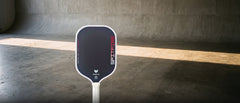

A note on this guide: we wrote it before the J6CR landed, so what it says about how the paddle plays is drawn from Honolulu's release notes and from our long-running experience with the J2CR predecessor. We have played the J6CR since, and our best durable grit paddles guide has where it sits. Use this one for how the J6CR differs from the J2CR on paper.
The J6CR: Honolulu's next-generation paddle, in two sentences
The Honolulu J6CR Crystal Blue takes everything Honolulu has built into the J2CR (the Gen 4.5 multi-density foam core, the durable Crystal Blue Endurance Surface, the signature blue colourway) and bolts it onto the longer, narrower J6 elongated frame. The result, on paper, is an elongated paddle with above-average twist-weight stability, elite spin numbers, and the same long-life face texture that's made the J2CR a quiet favourite among Australian club players.
The J6CR is A$308 at Pickld, the same RRP as the J2CR Crystal Blue, and it ships from Sydney. Honolulu makes these in batches, so a colour can sell through and go back on pre-order. The product page shows which it is today.
The Crystal Blue Endurance Surface: what makes it different
Most carbon-faced paddles lose their spin bite over time. The grit on the face wears smooth, and what felt like a high-spin paddle in month one feels like a flat slick paddle by month four. It's the single most underrated reason paddles get retired early.
Honolulu's Crystal Blue Endurance Surface (CBES) is the brand's answer to that wear curve. Rather than relying on the face's raw carbon weave for texture, Honolulu infuses the surface with a crystal-media process (a precision-applied layer of crystalline grit bonded into the face) that holds its bite far longer than standard carbon fibre. According to Honolulu's release notes, the J6CR's CBES produces a measured spin output of 2,296 RPM, which sits at the upper end of what we see on elongated paddles in this price band.
The signature blue colourway isn't just visual identity: it's the bonded crystal layer doing the work. We've watched the J2CR Crystal Blue hold its surface texture through months of heavy AU club play, where most raw-carbon paddles we've reviewed have noticeably smoothed off by the same point. That's the part of the Honolulu story we can speak to with genuine confidence: the surface lasts.
What's new in the J6CR vs the J2CR
Honolulu has effectively forked the Crystal Blue platform. The J2CR (Crystal Blue, regular and extended handles) is the wide hybrid shape with the Aero Hybrid Plus geometry. The J6CR is the same surface, same core family, on the elongated J6 frame. Here's how the two compare on the spec sheet:
| J2CR Crystal Blue | J6CR Crystal Blue | |
|---|---|---|
| Frame shape | Wide hybrid (Aero Hybrid Plus) | Elongated (J6) |
| Length | ~16.0" (standard hybrid) | ~16.5" (elongated) |
| Handle options | 5.5" regular or 6.0" extended | Single elongated configuration |
| Surface | Crystal Blue Endurance Surface | Crystal Blue Endurance Surface |
| Spin (release notes) | ~2,200 RPM | 2,296 RPM |
| Twist weight | Standard for wide hybrid | Up to 6.7, above average for elongated |
| Core | Gen 4.5 foam, multi-density pivoting | Gen 4.5 foam family |
| AU price | A$308 | A$308 |
The headline differences, drawn from Honolulu's release notes:
- Longer reach, more powerful swing arc. The 16.5-inch elongated length puts more mass further from your hand, which is what you want if you play an extension-heavy game: driving third shots, putaways from mid-court, two-handed backhand drives.
- A twist weight of up to 6.7. Elongated paddles typically trade off-centre stability for reach. A twist weight near 6.7 is unusually high for an elongated frame, closer to what you'd expect from a wider hybrid shape. If that number holds in independent testing, it's the most interesting thing about the J6CR.
- Same Crystal Blue surface, same durability profile. Spin output is up slightly to 2,296 RPM, which we'd expect from the longer head allowing more brushing contact on the ball, but the face technology itself is the proven CBES.
- Single handle configuration. Where the J2CR ships in both regular and extended handles, the J6CR launches as a single elongated unit. Honolulu may release a second handle option later. They haven't said.
Who the J6CR is built for
Based on the spec sheet and the way the J2CR has played for our intermediate-to-advanced Australian customers, the J6CR is shaping up as a paddle for:
- DUPR 3.5+ players who play an aggressive, extension-heavy game. If you drive third shots, hunt putaways from the transition zone, or rely on a two-handed backhand drive, the elongated frame's reach + the elevated twist weight is exactly the combination you want.
- J2CR Crystal Blue owners who've found themselves wanting more reach. If the J2CR's wide hybrid shape has felt slightly short on your backhand drives, the J6CR keeps everything you like about the face and core while extending the lever.
- Players upgrading from a raw-carbon elongated paddle whose face has worn smooth. The whole point of the Crystal Blue surface is that the spin you buy is the spin you keep. If your current elongated paddle is into month 6+ and the third-shot drop spin has dropped off, the CBES is built specifically for that problem.
Skip the J6CR if…
- You're a kitchen-line touch player who lives at the no-volley zone. The elongated frame is wrong for that game. Stay with the wider J2CR shape (regular or extended) for soft hands and the more forgiving sweet spot.
- You're brand new to elongated paddles. The shape is unforgiving on off-centre contact in a way the J2CR isn't. Even with the elevated twist weight, expect a learning curve.
Should existing J2CR owners upgrade?
This is the honest answer: probably not unless you've actually felt the J2CR run out of reach. The J2CR Crystal Blue is, in our experience with it on Sydney courts and via customer feedback, a very complete paddle for the kitchen-line-plus-occasional-drive player. The Crystal Blue surface holds up. The Gen 4.5 core has a soft, controlled feel. The wide hybrid shape forgives a lot of off-centre contact.
The J6CR is a different shape, not a strictly better paddle. If your game has evolved toward extension and power and the J2CR feels like a control-first answer to a power question, the J6CR is built for you. If you're happy with the J2CR's feel and you don't routinely wish you had more reach on drives, save your $308. The J6CR isn't going to fix something that isn't broken.
One genuine upgrade case: two-handed backhand drivers who've been on the J2CR extended-handle may find the elongated J6 frame adds a useful extra few centimetres of reach without losing the handle leverage. That's the player we'd most actively flag for an upgrade conversation.
Buying the J6CR at Pickld
- It ships from Sydney. The product page shows whether a colour is on the shelf or on pre-order today. If you need a paddle on a specific date, contact us first and we'll give you the latest read.
- Full AU warranty + 30-day return window once you've received it. The 30-day return clock starts when the paddle is delivered, not when you ordered.
Shop the Honolulu J6CR Crystal Blue
If the J6CR is the right paddle for your game, this is where to find it, with the J2CR beside it if you would rather have the wider shape.
- Honolulu J6CR Crystal Blue: A$308
- The wider alternative: J2CR Crystal Blue (regular handle): A$308
- The wider alternative: J2CR Crystal Blue (extended handle): A$308
- The full Honolulu lineup: Honolulu Pickleball Company collection
- Background reading on the Crystal Blue surface: our J2CR Crystal Blue review
Pickld is an authorised Australian Honolulu Pickleball dealer. Free AU shipping over A$150, full Australian warranty, 30-day returns from delivery date. Any questions about fit, or comparison with another paddle in the lineup: support@pickld.com.au goes straight to Ben and Chris.
Browse every model in our Honolulu pickleball paddles collection, shipped from Sydney.