


Spartus Spitfire vs Honolulu J6CR
Spartus Spitfire vs Honolulu J6CR is the most interesting price gap in durable grit right now. Both are 16mm elongated foam-core paddles with a grit face that independent wear tests put in the top tier, and one costs $170 while the other costs $308. If the grit is comparable, what are you paying the extra $138 for? The short answer: a longer handle, a softer and more controlled feel, and a paddle that a lot of players simply get on with faster. The Spitfire's answer is power, a USA Pickleball stamp, and $138 left in your pocket. You can browse every one of the Spartus pickleball paddles we stock in one place.
Every number below comes from our own product data for the paddles we hold, with the independently measured spin figures labelled separately so you can see which is the maker's claim and which is a tester's.
The verdict first
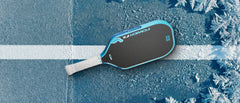
We would pick the Spartus Spitfire if you want power and spin, you are happy with a head-heavy paddle, or you play sanctioned events that use the USA Pickleball approved list. It is the better buy on pure value, and nothing else at $170 has a Tier 1 grit face.
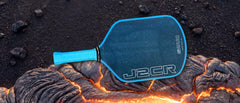
We would pick the Honolulu J6CR Crystal Blue if you want control first with power in reserve, you hit a two-handed backhand, or you want the most proven grit surface in the category. The 6 inch handle and the softer multi-density core are what the money buys, and they are real differences, not marketing.
Neither is a mistake. If you cannot decide, the handle length is the tie-breaker: 5.5 inches on the Spitfire, 6.0 inches on the J6CR. Measure the one you play now.
Specs side by side
| Spec | Spartus Spitfire Elongated 16mm | Honolulu J6CR Crystal Blue (Elongated) |
|---|---|---|
| Price | $170 | $308 |
| Shape | Elongated | Elongated |
| Core | Generation 4 Turbo Foam (EPP) | Multi-density foam (Core Reactor) |
| Face | QuadFiber carbon with PermaGritNano surface | Crystal Blue Endurance Surface (carbon fibre) |
| Core thickness | 16 mm | 16 mm |
| Weight | 223 g (7.85 oz, +/- 0.2 oz) | 227 to 233 g (8.0 to 8.2 oz) |
| Swing weight | 116 | 111 to 116 |
| Twist weight | 6.2 | 6.2 to 6.7 |
| Handle length | 5.5 in | 6.0 in |
| Grip circumference | 4.125 in | 4.125 in |
| Face size | 41.9 x 19.1 cm (16.5 x 7.5 in) | 41.9 x 19.1 cm (16.5 x 7.5 in) |
| Perimeter system | none quoted | Core Reactor plus control joint |
| Spin, maker's figure | 2,100+ RPM (Spartus) | 2,296 RPM (Honolulu) |
| Spin, independently measured | 2,132 RPM (Pickleball Effect) | 2,120 RPM (Pickleball Effect) |
| Grit wear test | 94% of Ra and 97% of Rz kept, Tier 1 (Pickleball Effect) | 97% of Ra and 92% of Rz kept, Tier 1 (Pickleball Effect) |
| Approval | USA Pickleball approved, PBCoR .43 | UPA-A |
| Who it suits (our tags) | Power, spin. Intermediate and professional | Control, power. Intermediate |
Approval lists change, so check the current list for your exact model before a sanctioned event.
The grit is a draw, and that matters
This is the unusual part of this comparison. Pickleball Effect put both faces through the same profilometer wear test and both came out Tier 1: the Spitfire kept 94% of its Ra and 97% of its Rz, the J6CR kept 97% and 92%. A typical raw carbon face keeps about 81% and 77%. The measured spin figures are within 12 RPM of each other.
So on the thing most buyers think they are choosing between, there is nothing to choose. The $138 is not buying you grit that lasts longer. Our durable grit guide has the full test table and the sources for both.
Where they genuinely differ
The handle, and it is the biggest difference
5.5 inches against 6.0 inches. Half an inch sounds like nothing until you try to fit two hands on the grip. If you hit a two-handed backhand, the J6CR is built for it and the Spitfire is a compromise. If you play one-handed, the Spitfire's shorter handle puts more of the paddle's length into the face, which is part of why it hits harder.
Power against control
The Spitfire is tagged power and spin in our catalogue; the J6CR is control and power. That matches how they feel. The Spitfire's EPP Turbo Foam core is a firmer, poppier build and reviewers consistently describe it as head-heavy. The J6CR's multi-density core with the Core Reactor and control joint is softer off the face, which buys you a longer dwell time at the kitchen and more margin on a reset.
Both sit at a swing weight of 116 at the top of their range, so neither is slow in a hands battle. The J6CR can come in as low as 111, which is noticeably easier to move.
Forgiveness
The J6CR's twist weight runs 6.2 to 6.7 against the Spitfire's 6.2, so the J6CR is at worst equal and at best more stable on an off-centre ball. If forgiveness is the priority, there is a third option: the Spitfire standard widebody has a twist weight of 7.4, the highest of any paddle in this comparison or the grit guide, at the same $170.
The rules
The Spitfire is stamped USA Pickleball approved. The J6CR is UPA-A only: Pickleball Effect measured its surface roughness at an Rz of 41.3, above the USAP limit of 30 before it has been played. For club and social play in Australia nobody checks, so this only matters if you enter sanctioned events, and then it is decisive.
Which one, by what you want
- Best value on grit that lasts: Spitfire, and it is not close on price.
- Sanctioned tournaments: Spitfire, for the USAP stamp.
- Two-handed backhand: J6CR, for the 6 inch handle.
- Soft hands and resets: J6CR, for the multi-density core.
- Raw power from the baseline: Spitfire.
- Most forgiving: the Spitfire standard widebody, at the Spitfire's price.
Read more
Our Spartus Spitfire article and Honolulu J6CR review cover each paddle on its own. The rest of each range is in Spartus pickleball paddles and Honolulu pickleball paddles, and if you want the whole category ranked rather than two paddles compared, start with our guide to the best pickleball paddles in Australia for 2026.
Both paddles ship from Sydney, with free Australian shipping over $150.
Pickld carries both brands, so we have a stake in what you buy. The specs come from each paddle's own product data and the wear and spin test figures come from Pickleball Effect, not from us.