The Luzz Cannon is a $155 paddle that measures like a $400 one on the two specs that describe how a paddle swings. That is the whole reason it is worth writing about, and it is also the reason to be careful: measuring like an expensive paddle and being one are different things, and this review is about where that line falls.
The short answer
Buy the Luzz Cannon if you are a club-level player who drives the ball, you want a thermoformed raw carbon power paddle, and you would rather spend $155 than $400. On swing weight it is genuinely in the conversation with paddles costing three times as much.
Skip it if you are still building consistency, or if your game is built on resets and dinks. This is a heavy-swinging, power-first paddle and it will punish a loose contact. The Luzz Glider at $159 is the control paddle in the same range and the better first Luzz for most people.
What the Luzz Cannon actually is
It is a thermoformed elongated power paddle, and the construction is more interesting than the price suggests.
The core is not a straight 16mm honeycomb. It is an 8mm polypropylene honeycomb wrapped in an enlarged foam layer out to 16mm total, with a U-shaped carbon fibre matrix running through the frame. The idea is that the foam and the matrix load progressively rather than the face simply bouncing off a hollow chamber, so energy builds through contact instead of arriving all at once.
The face is T700 raw carbon fibre with a directional friction texture, which is the same material class used on paddles at four times the price. A 3K carbon protection block guards the EVA edge, and the grip runs cooling channels over a shock-absorbing gel layer.
Luzz label it Gen 3. That is their own generation label, not an industry standard, and it means thermoformed rather than filled-foam. Worth knowing when you see Gen 4 on a spec sheet elsewhere, because those are different constructions and the number is not a ranking.
Luzz Cannon specs
| Spec | Luzz Cannon |
|---|---|
| Price | $155 |
| Shape | Elongated |
| Core | 8mm PP honeycomb + foam layer, 16mm total, U-shaped carbon matrix |
| Face | T700 raw carbon fibre, directional friction texture |
| Generation | Gen 3 (thermoformed) |
| Weight | 224g (7.9oz) |
| Swing weight | 121 |
| Twist weight | 6.2 |
| Paddle area | 42.0 x 19.0cm (16.5 x 7.5in) |
| Handle | 5.5in length, 4.125in circumference |
| Skill tier | Intermediate |
| Plays | Power, spin |
The number that makes this paddle interesting
Swing weight 121.
That number describes how heavy the paddle feels to move through the ball, and it is the single best predictor of whether a paddle drives well. For context, inside the Luzz range the flagship Pro 4 Tornazo at $335 measures 122. The Cannon is one point off it, for $180 less.
Look outside the range and it stays interesting. A JOOLA Perseus Pro V measures 114. An Aireo Cyclone measures 112. The Cannon swings heavier than both, which is not automatically better, but if what you want is mass behind a drive, this $155 paddle delivers more of it than paddles at $312 and $469.
The honest counterweight is the other number. Twist weight 6.2 is mid-table, and paired with a 121 swing weight it means an off-centre contact costs you more than it would on a lighter, more forgiving paddle. You are buying drive, and you are paying for it in margin for error.
Who the Luzz Cannon is for
- Club players who win points by hitting through people. Drives from the baseline, put-aways off a high ball, third shots you intend to hit hard rather than drop. The Cannon rewards that game.
- Players stepping up from a starter paddle. If your first paddle was a $99 carbon-face and you have outgrown it, this is a genuine jump in construction without a genuine jump in price.
- Anyone who wants a second paddle. At $155 it is a reasonable backup for a player whose main paddle costs three times as much.
Who should buy something else
- New players. A 121 swing weight is a lot of paddle to move while you are still learning where the sweet spot is. The Luzz Glider at $159 measures 111 swing and 6.4 twist, which is the more forgiving pairing, and it is the paddle we would hand a beginner.
- Control-first players. If your game is dinks, resets and third-shot drops that die in the kitchen, this is the wrong paddle at any price. The Six Zero Coral is what you want.
- Anyone chasing a filled foam core. The Cannon is thermoformed with a foam layer, not a filled foam core. If foam is specifically what you are after, see the step-up below.
The step up, and it is a real one
The Cannon is a very good paddle for the money. It is not the same class of paddle as the tier above it, and pretending otherwise would be doing you a disservice.
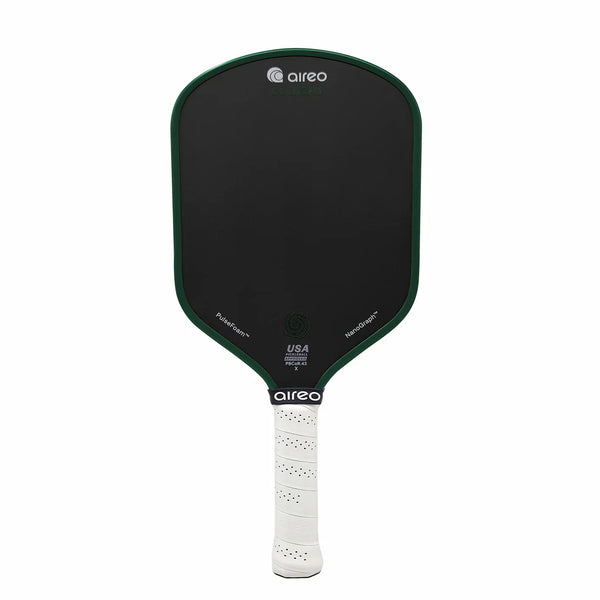
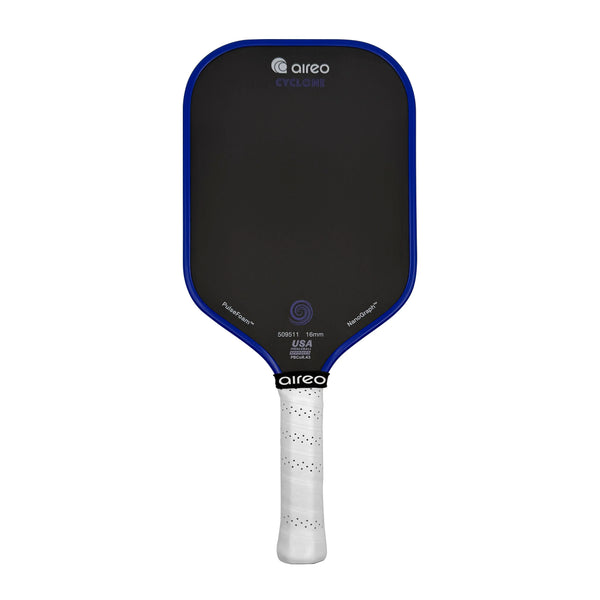
The nearest genuine step up we stock is the Aireo Cyclone at $312. It is a different construction: a filled PulseFoam microcellular core rather than a honeycomb with a foam wrap, behind a raw carbon NanoGraph grit face. It weighs 213g against the Cannon's 224g and swings at 112 against 121, so it is the lighter, quicker paddle of the two.
The reason to care is that independent testing backs it. PaddleReviewHub scores the Cyclone 8.8 for power and 8.8 for manoeuvrability, tied at the top of their card, and measured its spin at roughly 2,288 RPM. That is above the 2,188 JOOLA publishes for a Perseus Pro V costing $469. A power paddle that also swings light is rare, and that is what the extra $157 over the Cannon actually buys.
Whether that is worth it depends on you. If you play weekly, are comfortable at the kitchen line, and the paddle is now the thing limiting you, it is worth it. If you play socially and want to hit the ball hard, the Cannon does that for $155 and we would not talk you out of it.
Are Luzz paddles tournament legal?
Worth knowing if you enter sanctioned events, because there is history here. In March 2025 the UPA-A removed all Luzz paddles from its approved list over a submission-process issue: the Cannon had been submitted as a design variation of the ZZ model when it should have gone in as a new model. USAP, the separate body governing amateur play, was not part of that removal. Luzz re-submitted, models were re-approved from August 2025 onward, and Luzz is reinstated.
We are not going to tell you a specific model is certified today, because approved-equipment lists change and your event runs under its own sanctioning body's rules. Check the current official UPA-A and USAP lists for your exact model before you enter. The full story is in are Luzz pickleball paddles banned, and if you cannot find your model, email support@pickld.com.au and we will chase it for you.
The Cannon and the rest of the Luzz pickleball paddles we stock ship from Sydney.
Common questions
Is the Luzz Cannon good for beginners? No, and we would rather say so. The 121 swing weight and 6.2 twist weight make it a demanding paddle for a developing contact. The Glider is the beginner paddle in this range.
How does the Luzz Cannon compare to the Pro 4 Inferno? Both are elongated 16mm power paddles with similar swing weights, 121 against 119. The Cannon is $155 with an 8mm honeycomb wrapped in foam behind a T700 face. The Inferno is $329 with a full MPP microporous foam core and a one-year warranty. The Inferno is the more advanced construction; the Cannon is the better value. We broke the whole range down in our Luzz range guide.
Is the Cannon a copy of a more expensive paddle? It shares a material class, T700 raw carbon, with paddles at four times the price, and it swings like a flagship. It does not share the core construction, the iteration history or the quality-control budget. Calling it a copy oversells it. Calling it excellent value at $155 is accurate.
What is the difference between Gen 3 and Gen 4? On a Luzz spec sheet, Gen 3 means thermoformed with a honeycomb core and Gen 4 means a filled foam core. It is Luzz's own label, not an industry standard, so it tells you nothing across brands. Our paddle jargon explainer unpacks the terms properly.
The verdict
The Luzz Cannon is the best value power paddle we stock. A thermoformed T700 raw carbon elongated paddle with a 121 swing weight, at $155, is not a compromise buy, it is a genuinely good paddle that happens to be cheap. What you give up against the tier above is forgiveness, refinement and a filled foam core, and whether that matters depends entirely on how you play.
If you drive the ball and you want to spend $155, buy it. If you have outgrown a starter paddle and want the biggest jump per dollar available on our shelf, buy it. If you want the quickest, most modern construction and you can stretch, the Aireo Cyclone is the paddle to stretch to.
The Pickld bit
The Cannon ships from our Sydney warehouse with free Australian shipping over $150, which it clears on its own, and a 30-day return on factory-fresh paddles. Pickup is available on Sydney's North Shore (Mt Colah). Stock is live on the product page, which is the honest source on availability rather than this article. The full range sits in the Luzz collection.
Pickld sells every paddle named here and makes money either way, which is exactly why this review tells you who should not buy the Cannon. Not sure whether to spend $155 or $312? Hit reply and tell us how you win your points, and we will give you a straight answer, including when the answer is the cheaper one.
Ben