


The ATP in pickleball is the shot that makes everyone at the next court turn around: the ball goes around the net post instead of over it, below net height, and lands in. It looks like a mistake until you know it is completely legal. The Erne is its twin at the other end of the kitchen line, and it is legal too. Neither needs a special paddle, though the shape of the one already in your bag does change how easy each is, which is the last section of this guide. Everything we stock sits in pickleball paddles if you want to compare shapes while you read.
What an ATP in pickleball actually is, and why it is legal
ATP stands for around the post. You take a ball that has drifted wide, past the sideline, and you hit it around the outside of the net post rather than over the net. It can travel at ankle height. It can be lower than the net the whole way. As long as it lands inside the correct court, the point is yours.
The reason people assume it is illegal is that they assume the ball has to cross above the net. It does not. There is nothing in the game that says the ball must pass over the net or between the posts, only that it has to land in. Once that clicks, a ball pulled wide stops being a problem and starts being an opportunity.
Two things will still lose you the point: touching the net or the post while you play it, and reaching across the net plane to hit the ball before it has crossed to your side. Wait for it to come to you.
When the ATP is actually on
This is the part that separates the players who hit ATPs from the players who try one a month and shank it into the fence. Three things have to be true at once.
- The ball is travelling away from the court, not along it. A wide dink that is still heading towards the sideline is an ATP. A wide dink that has already started coming back in is a normal backhand.
- It is low and it is wide of the sideline. If you can get your paddle outside the post, the geometry opens up. If the ball is still inside the sideline, there is no gap to go through.
- You have time to get your feet outside the court. An ATP is hit from off the court, not from on it. If you are reaching, you are not set, and you will hit the post.
Most ATP chances come off a cross-court dink exchange, which is why players who dink cross-court a lot see more of them. If your dinks are all straight ahead, read our guide to how to hit a dink and when to use it and start taking a few of them across.
How to hit one
- Move early and move out, not forward. The first step is sideways and slightly back, taking you outside the sideline. Crowding the ball is the single most common reason an ATP goes into the net post.
- Drop your paddle head below the ball. You are hitting up through it, not down on it. Low ball, low paddle, open face.
- Aim at the court, not at your opponent. The temptation is to smash it. Do not. Aim for the middle of the open court with pace you can control, because the margin here is the sideline, not the net.
- Swing through the line of the ball. Keep the face going towards the target for as long as you can. A flicked wrist at the last moment is what sprays these wide.
- Do not watch it. Recover towards the middle as you finish. The good ones come back.
The Erne: the same idea at the other end of the line
The non-volley zone sits either side of the net and runs between the two sidelines. The word that matters there is between. Outside the sideline, next to the net, there is no non-volley zone at all, which means you can stand there and volley a ball out of the air right at the net.
That is an Erne. You get there one of two ways: run around the outside of the kitchen and set up beyond the sideline before the ball arrives, or jump from behind the non-volley zone line across the corner of the kitchen and land outside the sideline, hitting the ball while you are in the air. Either is legal. What is not legal is touching the non-volley zone or its lines while you volley, and that includes anything your momentum does to you afterwards. Land outside the court and stay outside it.
The Erne is a trap, not a rally shot. It works on an opponent who dinks to the same spot every time, and it stops working the moment they notice you leaving. Use it twice a match, not twice a game. The full detail on where the line sits and what counts as touching it is in our pickleball kitchen rules guide.
The mistake that costs you both shots
Both shots fail the same way: the player goes early. Leave for an Erne before your opponent has committed and they will simply dink the other way into the space you vacated. Commit to an ATP before the ball is past the sideline and you will be stuck off the court with a ball you now have to hit over the net from a terrible angle.
The fix is boring and it works. Hold your position until the ball has told you what it is doing, then go. Everything about these two shots is timing, and nothing about them is strength. If you want the broader picture of when to take a risk and when to keep the rally going, our pickleball strategy guide covers the trade-off properly.
The paddle that makes each one easier
These shots want opposite things, which is a neat illustration of why paddle shape matters more than most people think. Our explainer on elongated, widebody and hybrid paddle shapes goes deeper, but here is the short version for these two shots.
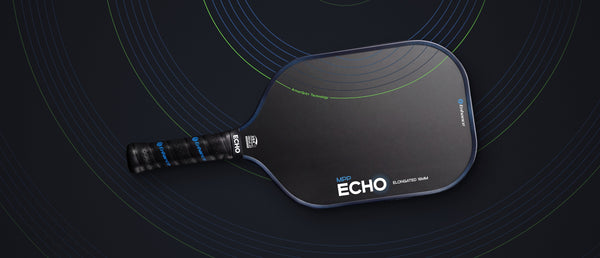
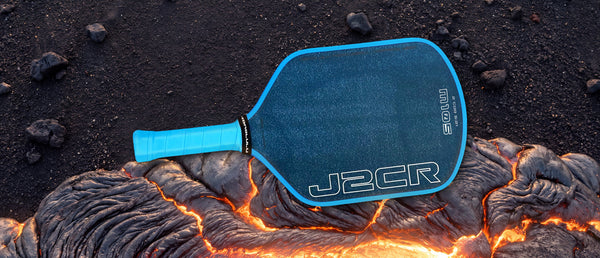
For the ATP, reach and bite. An elongated head gets your paddle further outside the post, and a gritty face lets you brush up on a low ball instead of having to lift it. The RPM Jade ($374) is the clearest example we stock: in its elongated build the face measures 41.9 x 19.1 cm (16.5 x 7.5 in), the handle is 5.5 in, and the face is SICmatrix silicon carbide over an MPP floating core with an EVA perimeter. Swing weight is 112 elongated, so it does take a bit more arm to move. The whole range sits in RPM pickleball paddles.
For the Erne, hands. You are volleying at the net with no time, so you want a stable face and a quick one. A widebody gives you a broader hitting surface right where a reflex volley lands. The JOOLA Scorpeus Pro V (Anna Bright) 16mm ($299.95) is 40.6 x 20.3 cm (16.0 x 8.0 in) across a 16 mm honeycomb Propulsion polymer core with a textured carbon fibre face, 232 g, and a shorter 5.25 in handle that keeps it manoeuvrable in tight. More of the range is in JOOLA pickleball paddles.
To be clear, you do not need either of these to hit either shot. Play the one you own. This is a "which would help" answer, not a "which do you need" answer.
Where to practise them
The ATP is the easier of the two to drill, because you do not need a partner to feed it well. Stand off the court with a bucket of balls, drop and hit around the post, and keep going until the contact point stops feeling strange. Twenty minutes buys you the shot. Our guide to pickleball drills without a partner has more solo work along the same lines, and the third shot drop is the other shot worth the same twenty minutes.
The Erne you have to practise with someone, because the whole shot is reading when they are about to dink to the same spot again. Ask a hitting partner to dink cross-court to you ten times in a row and leave on the eighth. You will get a feel for how early is too early fairly quickly.
Both of these are the kind of shot that makes the game more fun before it makes you better, and that is a perfectly good reason to learn them. If you try one this weekend and it works, hit reply and tell us. We like hearing about those.
Chris
Pickld carries the brands featured here. Picks are based on customer order data and product specs, not affiliate incentives. Free Australian shipping over $150, excluding bulky items.