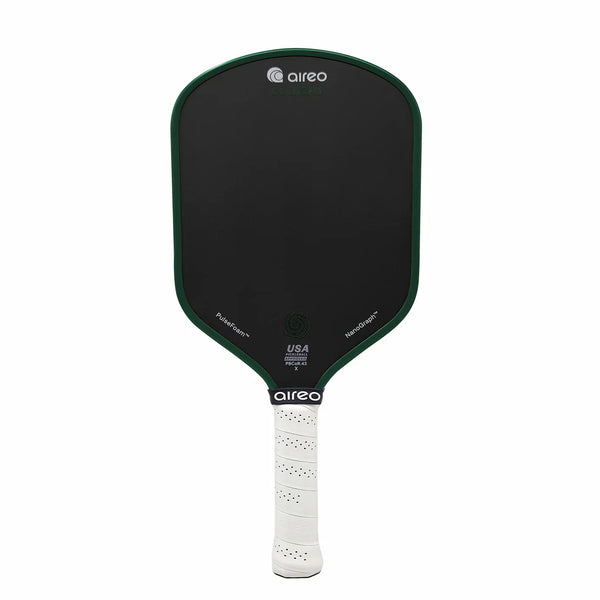
The Aireo Cyclone and the Cyclone X Hybrid are the same paddle in two shapes. Same 16mm PulseFoam core, same raw carbon NanoGraph face, same $312. That makes this an unusually clean decision, because the shape is the only thing you are actually choosing. Both sit in the Aireo paddles we stock in Australia.
The short answer
If you win points by driving through the ball, reaching wide and hunting put-aways, take the Cyclone: the elongated head gives you leverage and reach. If you win points with hands at the kitchen, resets and quick exchanges, take the Cyclone X Hybrid: the shorter, wider head is the more forgiving of the two and swings a fraction faster.
Quick pick. Aggressive baseline and mid-court players: Cyclone. All-court and kitchen-line players: Cyclone X Hybrid. Genuinely unsure, or coming off a widebody: the Hybrid is the lower-risk starting point, because an elongated head takes some getting used to and a hybrid does not.
What both shapes share
Most of the paddle is common ground, so it is worth being clear about what you are not choosing between.
Both run a 16mm PulseFoam core, a microcellular foam that fills the paddle rather than leaving a hollow honeycomb chamber behind the face. In play that means the ball dwells on the face slightly longer, and the pop comes back solid rather than tinny. Both use the same raw carbon NanoGraph grit surface, which is where the spin comes from. Both use Aireo's Floating Foam Suspension around the perimeter. Both are USAP approved, so they are tournament-legal out of the wrapper. Both are $312.
If the words foam core, thermoformed and Gen 4 are doing a lot of work in paddle marketing you have read lately and you want them in plain English, our paddle jargon explainer unpacks the lot. And if you want the full play-by-play on how the Cyclone performs rather than just the shape decision, that lives in our Aireo Cyclone review. This piece is only about picking the right shape.
The Cyclone: the elongated shape
An elongated head moves mass away from your hand and toward the tip. Two things follow, and they are the same two things on every elongated paddle ever made.
The good: leverage. Every drive, overhead and put-away has more paddle travelling faster at the point of contact, so the ball leaves harder for the same effort. You also get reach, which matters more than most people expect on the wide ball you would otherwise have to let go, and on the low volley you have to stretch for. A two-handed backhand gets a longer lever to work with.
The cost: forgiveness. The face is narrower, so the sweet spot is a longer, thinner strip rather than a broad oval, and off-centre contact near the throat punishes you more. The head also takes marginally longer to get moving, which you notice in a fast hands battle at the kitchen line rather than anywhere else.
That trade is not a flaw. It is the entire point of the shape. Take the Aireo Cyclone if you already know you swing at the ball and you want the extra weight behind it.
The Cyclone X Hybrid: the middle ground
A hybrid sits between elongated reach and widebody forgiveness. You give up some of the tip leverage and you get back a broader sweet spot and quicker hands.
Where you feel it: firefights. When four players are exchanging volleys inside the kitchen line, the paddle that gets there first wins the point, and the hybrid gets there first. You also feel it on the mishit. The wider face means the ball you catch slightly off-centre still goes roughly where you aimed it, which over a long session is worth more points than the extra power you traded away.
Where you miss the elongated: the stretch volley, the wide dig, and the put-away you wanted to end emphatically. The Cyclone X Hybrid still has plenty of pop, it just asks you to generate a bit more of it yourself.
Side by side
| Spec | Aireo Cyclone | Aireo Cyclone X Hybrid |
|---|---|---|
| Shape | Elongated | Hybrid |
| Core | 16mm PulseFoam (microcellular foam) | 16mm PulseFoam (microcellular foam) |
| Face | Raw carbon fibre, NanoGraph grit | Raw carbon fibre, NanoGraph grit |
| Weight | 213g (7.5oz) | 215g (7.6oz) |
| Swing weight | 112 | 107 |
| Twist weight | 6.2 | 6.5 |
| Handle length | 5.7in | 5.6in |
| Perimeter | Floating Foam Suspension | Floating Foam Suspension |
| Leans | Power, reach, spin | All-court, hands, spin |
| Certification | USAP approved | USAP approved |
| Price | $312 | $312 |
The two numbers that settle it
You do not have to take our word for the shape argument, because the specs say it outright.
Swing weight: 112 elongated, 107 hybrid. That is how heavy the paddle feels to move, and the hybrid is meaningfully quicker. In a kitchen-line firefight, five points of swing weight is the difference between getting the paddle there and not.
Twist weight: 6.2 elongated, 6.5 hybrid. That is how much the head resists twisting when you catch the ball off-centre. Higher is more forgiving, so the hybrid punishes a mishit less. For context, a JOOLA Perseus Pro V sits at 6.53, so the Cyclone X is within a rounding error of a paddle costing $157 more.
Two independent US reviewers have measured these paddles and landed on the same figures. PaddleReviewHub put the hybrid at roughly 107 swing and 6.7 twist; Spinwave measured the elongated at 113.5 and 6.3. Both sit inside a whisker of what Aireo publishes, which is not something you can say about every brand.
PaddleReviewHub also measured the hybrid's spin at roughly 2,288 RPM, and scored it Power 8.8 and Manoeuvrability 8.8, tied at the top of their card. That pairing is the whole point of these paddles: an elongated power paddle usually buys its power with a heavy swing, and this one does not.
So which one should you buy?
- You drive the ball and hunt put-aways: Cyclone. The extra leverage is exactly what you are paying for.
- You play a patient soft game and win at the kitchen: Cyclone X Hybrid. Hand speed and forgiveness beat reach in that game every time, and the numbers above say so.
- You run a two-handed backhand: either works, but the Cyclone's longer 5.7in handle suits it better if that wing is your weapon.
- You are coming off a widebody and this is your first step up: Cyclone X Hybrid. Elongated paddles reward an adjustment period, and there is no need to spend it while you are also learning a new core.
- You play singles more than doubles: Cyclone. Court coverage and serve leverage matter more than kitchen hand speed.
- You prefer a dense, control-first feel: honestly, neither. Spinwave make this point in their review and we agree with it. These are high-pop paddles and they reward a player who wants that. If you want muted and plush, the Six Zero Coral is the better paddle for you.
- You are new to the game: neither. A 16mm foam-core power paddle at $312 is more paddle than a beginner needs. Start with our beginner guide and the Starter Pickleball Paddles collection instead.
Common questions
Is the elongated Cyclone harder to use? Not harder, less forgiving. Twist weight 6.2 against the hybrid's 6.5, so the sweet spot punishes a mishit slightly more. A session or two of adjustment is normal. If you have played an elongated paddle before, you will feel at home immediately.
Do the two shapes hit with different power? The core and face are identical, so the raw material is the same. The elongated head lets you apply that material with more leverage, which reads as more power on a full swing and makes very little difference on a block or a reset.
Can I try both? Not on a demo program yet, we are not there. What we can do is talk it through: tell us how you play and we will tell you which one we would hand you, including if the answer is neither.
If neither Cyclone is the one
Aireo is not the only foam-core option in Australia and we would rather sell you the right paddle than the newest one. The Friday Aura Elongated at $215 is the value pick in this construction, and the Aura Pro at $275 is the softer, more control-led version of the same idea (we did this exact shape breakdown for that line in our Friday Aura hybrid vs elongated guide). At the other end, the JOOLA Perseus Pro V at $469 is the tour-proven elongated paddle, and we put it head to head with the Cyclone in this comparison. Browse the lot in Pickleball Paddles.
The Pickld bit
We import Aireo ourselves, so both Cyclones ship from our Sydney warehouse with free Australian shipping over $150, a 30-day return on factory-fresh paddles, and Aireo's manufacturer warranty on defects, which we handle for you rather than sending you offshore. Pickup is available on Sydney's North Shore (Mt Colah).
Pickld carries every brand named here. Picks are based on how the paddles are built and how they play, not on which one earns us the most. Still stuck between the two shapes? Hit reply on any Pickld email and tell us how you play, and we will point you at the right one.
Ben