Two elongated 16mm paddles, both built for the modern power-and-spin game, $157 apart. The JOOLA Perseus Pro V at $469 is the most recognised paddle in the sport, Ben Johns' own. The Aireo Cyclone at $312 is a Gen 4 full-foam paddle that independent US testing scores 8.8 for power and 8.8 for manoeuvrability, which is a pairing you almost never see on the same card. We sell both, so this is not a sales pitch dressed as a comparison. It is what the $157 actually buys.
The short answer
Buy the Perseus Pro V if you play competitively, if you mishit more than occasionally, or if you want the paddle with five generations of refinement and a name every opponent recognises. It is the more forgiving of the two and that is not a small thing at this level.
Buy the Aireo Cyclone if you want a filled foam core in a lighter, faster-swinging paddle, and you would rather keep $157 than buy the badge. On the measured numbers it is the quicker paddle and it does not give up spin to get there.
Buy neither if you are a 3.0 to 3.5 player still working out your game. At that level the paddle is not what is holding you back, and there are $215 paddles that will not cost you a single point. More on that at the bottom.
Where the two paddles actually differ
Both are elongated, both are 16mm, both use a textured raw carbon face, both are tournament-legal. The meaningful split is the core.
The Perseus Pro V uses JOOLA's Honeycomb Propulsion polymer core with a KineticFrame throat. That is a honeycomb structure, so there is air behind the face, and JOOLA engineers the frame and throat to control what that air does. It is the construction almost every top-tier paddle has used for the last five years, and it is refined to within an inch of its life.
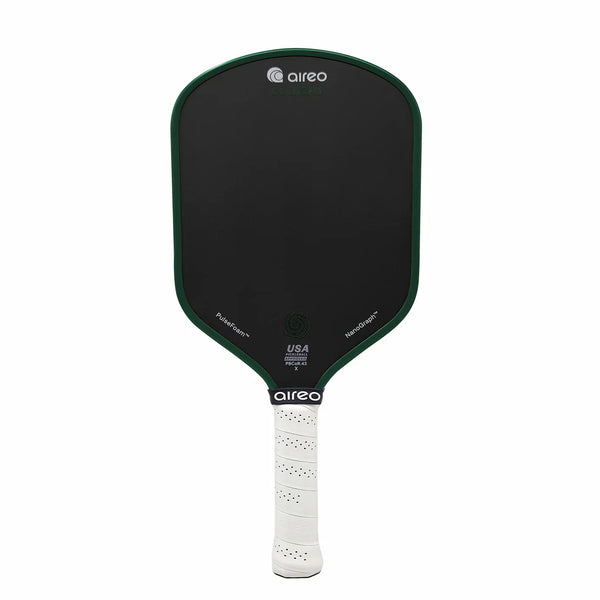
The Aireo Cyclone uses a 16mm PulseFoam core, a microcellular foam that fills the paddle rather than leaving a honeycomb chamber, wrapped in Aireo's Floating Foam Suspension around the perimeter. The face is raw carbon with a grit surface Aireo calls NanoGraph. This is what the industry means by Gen 4: a filled foam core rather than a hollow one.
What that difference does in play: a filled foam core holds the ball on the face a fraction longer and returns it with a solid, slightly deeper feel, where a honeycomb core tends to feel crisper and more immediate. Neither is better. Players who have moved to foam usually say resets got more predictable; players who have moved back usually say they missed the crispness. If foam core, thermoform and Gen 4 are still fuzzy terms, our paddle jargon explainer sorts them out.
The numbers, side by side
| Spec | Aireo Cyclone | JOOLA Perseus Pro V 16mm |
|---|---|---|
| Price | $312 | $469 |
| Shape | Elongated | Elongated |
| Core | 16mm PulseFoam (filled microcellular foam) | 16mm Honeycomb Propulsion polymer |
| Face | Raw carbon, NanoGraph grit | Textured carbon fibre |
| Perimeter / throat | Floating Foam Suspension | KineticFrame throat |
| Weight | 213g (7.5oz) | 230g (8.1oz) |
| Paddle area | 41.8 x 19.1cm (16.5 x 7.5in) | 41.9 x 19.1cm (16.5 x 7.5in) |
| Swing weight | 112 | 114 |
| Twist weight | 6.2 | 6.53 |
| Measured spin | ~2,288 RPM (hybrid, PaddleReviewHub) | 2,188 RPM (JOOLA published) |
| Grip | 5.7in length | 5.5in length, 4.25in circumference |
| Certification | USAP approved | USAP approved |
| Stocked in Australia by | Pickld | Multiple retailers |
Read that table honestly, because it does not say what you might expect. The Cyclone is 17g lighter than the Perseus, swings lighter with it (112 against 114), and its handle is 2mm longer, which matters if you hit a two-handed backhand. Where the Perseus wins is the number that describes forgiveness: a twist weight of 6.53 against the Cyclone's 6.2. That is the real trade at this price, and it is narrower than the badge on the paddle suggests.
What the independent testers found
We are a shop, so take our read with the appropriate pinch of salt and go and check the people who test paddles for a living.
PaddleReviewHub measured the Cyclone hybrid at roughly 2,288 RPM of spin, and scored it Power 8.8, Manoeuvrability 8.8, Pop 8.7, Spin 8.6, with Control and Forgiveness both at 8.0. JOOLA publishes 2,188 RPM for the Perseus Pro V. On the spin number that most buyers care about, the cheaper paddle measures higher.
Spinwave measured the elongated Cyclone at 113.5 swing weight and 6.3 twist weight, both within a whisker of what Aireo publishes, and called it "a high-powered, elongated foam core paddle with a surprisingly light swing weight". They rate its power just short of the top of the market, and note it swings meaningfully faster than a Bread and Butter Loco at 118 to 120.
The criticism is worth carrying too, because it is the honest counterweight: Spinwave do not recommend the Cyclone for players who prefer a dense, control-first feel. If that is you, this is not your paddle at any price, and the Perseus is closer to what you want.
What the extra $157 buys
Three things, and they are all real.
- Forgiveness you can verify. The Perseus Pro V's twist weight is 6.53 against the Cyclone's 6.2. That number describes how much the head resists twisting when you catch the ball off-centre, and 6.53 is high for an elongated paddle. For comparison, the RPM Q2 Elongated sits at 6.1 and the Friday Aura Pro Elongated at 6.15. If your contact is inconsistent, this is the single most valuable thing on this page.
- Refinement. The Pro V is the fifth generation of a paddle that thousands of high-level players have hit with and complained about until JOOLA fixed things. Aireo has not had that many iterations yet. That gap tends to show up in the small stuff: how consistent one unit is against another, how the face wears at six months.
- Recognition and resale. A Perseus holds value and everybody at your club knows what it is. An Aireo does not and they do not, at least not yet.
What the $157 does not buy
It does not buy a foam core, because the Perseus does not have one. If the reason you are shopping is that you have hit a foam-core paddle and liked what it did to your reset game, the Perseus is not the answer to that at any price.
It does not buy more spin. Independent testing puts the Cyclone above the Perseus on measured RPM, and that is the opposite of what the price gap would lead you to assume.
It does not buy a lighter or faster paddle. The Cyclone is 17g lighter and swings two points lighter, and if you have ever finished a long session with a sore shoulder that is not a small detail.
It also does not buy more raw power, as far as we can tell. Both paddles hit hard. Neither of us could pick a meaningful difference in put-away weight between them, and we are not going to invent one to make the table look tidier.
Both brands are stocked in Sydney: browse the Aireo pickleball paddles and the JOOLA pickleball paddles side by side.
The questions people actually ask
Is the Aireo just a cheaper copy of the JOOLA? No, they are built differently. Filled foam core against polymer honeycomb is a genuine engineering difference, not a cost-down of the same idea. The Cyclone is a cheaper paddle than the Perseus, and it is also a different paddle.
Why is the Aireo cheaper if it is not worse? Mostly because it is younger. JOOLA funds a tour roster, a marketing operation and five generations of R&D, and that sits in the price of a Perseus alongside the paddle itself. Aireo has none of that yet. We would not tell you the Cyclone is $157 better value, we would tell you $157 of the Perseus price is buying things that are not the paddle.
What happens to my warranty on a brand nobody stocks? We import Aireo ourselves, so a warranty claim comes to us in Sydney and we handle it here rather than routing you to an overseas support desk. The flip side is worth saying out loud: if we ever stopped carrying Aireo, there would be no other Australian retailer to fall back on. With JOOLA there would be several.
So which one?
- Tournament player, or anyone whose contact is inconsistent: Perseus Pro V. The 6.53 twist weight is the argument and it is a good one.
- You want foam core, light weight and fast hands: Aireo Cyclone. Lighter, quicker, more measured spin, and $157 left over.
- You want the more forgiving Aireo: the Cyclone X Hybrid at the same $312 measures 107 swing and 6.5 twist, so it swings faster and forgives more than the elongated. We compare the two shapes here.
- You are a 3.0 to 3.5 player and this is your second paddle: genuinely, buy neither. The Friday Aura Elongated at $215 will not cost you a point at that level and leaves $250 for coaching. We ran the numbers on that exact question in mid-tier versus pro-tier paddles, and the honest answer surprised us too.
Where to look next
The full JOOLA line, including the Scorpeus and Agassi variants, is in the JOOLA Paddles collection, and we have broken the whole range down in our JOOLA range guide. If it is the Perseus specifically you are weighing up, our Perseus Pro V review goes deeper than this comparison does. Both Aireo paddles sit in the Aireo collection, and the Cyclone gets the full treatment in our Aireo Cyclone review.
The Pickld bit
Both paddles ship from our Sydney warehouse with free Australian shipping over $150 and a 30-day return on factory-fresh paddles. Pickup is available on Sydney's North Shore (Mt Colah). Perseus stock moves quickly, so the product page is the honest source on availability, not this article.
Pickld sells both paddles compared here and makes money either way, which is exactly why this piece tells you what each one is missing. Not sure which side of the $157 you fall on? Hit reply and tell us how you play and how often you catch the ball off-centre, and we will give you a straight answer.
Ben