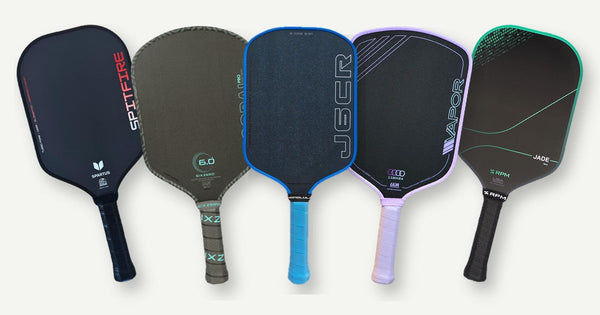
Nearly every serious paddle sold in Australia today is a carbon fibre pickleball paddle. That sounds like it settles the question, and it does the opposite: "carbon fibre" covers a $99 paddle and a $380 paddle, and the gap between them is not the word on the box. It is the grade of fibre, how many layers of it there are, which way those layers run, and what the factory does to the surface afterwards.
Here is what a paddle face is actually made of, what the fibreglass question is really asking, and what our own recorded spin numbers show about which of it matters.
What a carbon fibre pickleball paddle face is actually made of
A modern paddle is three things pressed together: a core, a face on each side of it, and whatever treatment sits on top of that face. Our foam core and thermoforming explainer covers the middle layer. This one is about the outside.
The face is a woven sheet of fibre set in resin. Three fibres are used in paddles worth buying:
- Carbon fibre. Stiff, light, and it barely flexes on contact. A stiff face means the ball leaves quickly and predictably, and it means the texture on the surface gets to grab the ball instead of the face swallowing it. This is why the category moved to carbon and stayed there.
- Aramid, sold as Kevlar. Slightly softer than carbon and much better at damping vibration. It gives a muted, plush feel at the kitchen without going dead.
- Fibreglass. Cheaper, heavier for the same strength, and noticeably flexier. It gives a lively pop off the middle and very little bite.
Carbon fibre grades: T300, T700 and what the numbers mean
If you have compared spec sheets you have seen T300 and T700. Those are Toray's own grade names for the raw fibre, and the numbering runs upward: T700 is a stiffer, stronger fibre than T300. Brands quote it because it is one of the few genuinely comparable numbers on a paddle.
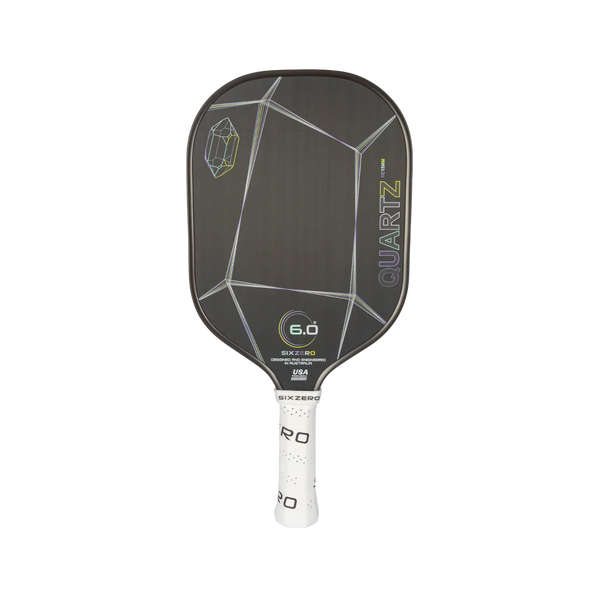
Two paddles on our shelf make the grade difference easy to see, because they come from the same brand and the same design language. The Six Zero Quartz at $99 runs a T300 raw carbon fibre face. The Six Zero Sapphire at $149.99 steps up to Toray 700K raw carbon. Fifty dollars, one grade of fibre, and our recorded spin figures move from 1,945 rpm to 2,175 rpm.
That is a real difference, and it is also smaller than most people expect for a paddle that costs half as much again. The Quartz is still the paddle we hand to people starting out, and we wrote up why in the Six Zero Quartz review.
Layers and direction matter as much as grade
Grade is one variable. How the sheet is built is another, and brands are less loud about it.
Layer count is the simple one: more plies of carbon make a stiffer, more durable face. Fibre direction is the interesting one. A standard face runs its weave square to the paddle, along and across. The Franklin C45 Anna Leigh Waters 14mm at $379.99 instead lays its T700 raw carbon at 45 degrees, which is where the C45 name comes from. Turning the weave changes how the face resists twisting rather than how hard it hits, and the paddle's recorded twist weight of 5.96 and very low 97.5 swing weight tell you what that build is for: a fast, manoeuvrable hand-battle paddle rather than a baseline cannon.
The fibreglass question, answered honestly
People search "carbon fibre vs fibreglass pickleball paddle" expecting a fair fight. There is not one any more, and we would rather say so than sell around it.
We do not stock a single fibreglass-faced paddle. Not one paddle in our active range has fibreglass in its face spec. That is a deliberate choice, not an oversight.
Fibreglass flexes on impact. That flex feels lively, almost springy, off the middle of the face, which is why it dominated cheap paddles for years and why a fibreglass paddle can feel surprisingly punchy the first time you hit with it. The cost is control and spin. A face that gives under the ball cannot grip it, so the texture on the surface has less to work with, and the extra flex makes the ball come off differently depending on where it lands. You get pop and you give up the touch shots.
If you are choosing between a carbon paddle and a fibreglass one at a similar price, take the carbon one. If the fibreglass paddle is dramatically cheaper, what you are really choosing is whether to buy a paddle at all yet, which is a fine question with a different answer. Our beginner pickleball paddles start at $99 with a real carbon face, so the old reason to accept fibreglass has largely gone.
Kevlar: the alternative that is actually alive
The genuine non-carbon option in 2026 is aramid. The Six Zero Ruby at $249 runs a Kevlar face, and it is a different sensation rather than a worse one: the ball sits on the face a fraction longer and the whole paddle is quieter through the hand. Our recorded figure for it is 2,200 rpm, ahead of both raw carbon Six Zeros, on a 16 mm hybrid with a 117 swing weight.
Kevlar suits players who reset and dink more than they bang, which is the same brief our control pickleball paddles are built around. It is not the move if you want the crispest possible put-away.
The face is only half of it: what goes on top
Here is the part that undoes most assumptions about fibre grade. The texture applied over the carbon does more for spin than the carbon itself.
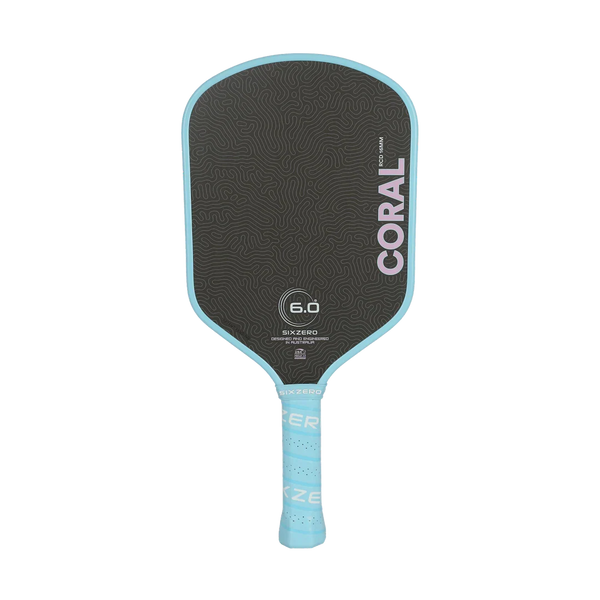
"Raw carbon" means the weave is left exposed with its peel-ply texture rather than painted over. Several brands then go further and build a treated surface on top. The Honolulu J2CR Crystal Blue at $308 wraps its carbon in the Crystal Blue Endurance Surface. The Six Zero Coral Pro 16mm at $300 uses Diamond Grit over Diamond Tough carbon, and records 2,481 rpm, the highest figure of any paddle in this article.
How long that treatment survives is its own question, and we tested it separately in our guide to durable grit. Worth reading before you spend on a heavily textured paddle, because a surface that wears off in two months is a spin number with an expiry date.
What the numbers show
Every figure below is the spec we hold against that product, pulled the day this was written. Prices are current and all six are in stock.
| Paddle | Face material | Spin (rpm) | Price |
|---|---|---|---|
| Six Zero Quartz | T300 raw carbon fibre | 1,945 | $99 |
| Franklin C45 Anna Leigh Waters 14mm | 45-degree T700 raw carbon fibre | 2,011 | $379.99 |
| Honolulu J2CR Crystal Blue | Crystal Blue Endurance Surface (carbon) | 2,091 | $308 |
| Six Zero Sapphire | Toray 700K raw carbon fibre | 2,175 | $149.99 |
| Six Zero Ruby | Kevlar (aramid fibre) | 2,200 | $249 |
| Six Zero Coral Pro 16mm | Diamond Grit (Diamond Tough carbon) | 2,481 | $300 |
Read the first and last columns together and the point lands: price does not buy spin. The most expensive paddle here measures second lowest. The $149.99 Sapphire out-measures the $379.99 C45. The highest number belongs to a $300 paddle.
That is not a knock on the C45, which is doing a different job and doing it well. It is the actual lesson of face materials: fibre grade sets the floor, the surface treatment sets the ceiling, and a paddle's price is mostly paying for the core, the build quality and the player whose name is on it.
Four of the six are Six Zero on purpose. It is the only brand we carry that sells four genuinely different face materials across one house design, so it is the one place you can change the fibre and hold nearly everything else still. You can see the full spread in our Six Zero pickleball paddles.
Which face should you actually buy?
- Starting out, or replacing a supermarket paddle: any raw carbon face will do, and the Quartz at $99 is the cheapest honest one we sell.
- You want spin above all: stop reading fibre grades and look at the surface treatment. Coral Pro territory, and the rest of our spin pickleball paddles.
- You reset, block and dink: try Kevlar. The Ruby is the one to hit.
- You live in hands battles: fibre direction and a low swing weight matter more than grade, which is the C45's whole argument.
- You are not sure: face material is the last thing to decide, not the first. Core thickness and weight change how a paddle plays far more. Our paddle finder walks it in order.
Everything discussed here sits in our full range of pickleball paddles, and if you would rather skip to the shortlist, that is what our best paddles guide is for. Free AU shipping over $150.
Common questions
What are pickleball paddles made of?
A core, usually polypropylene honeycomb or moulded foam, with a face of carbon fibre or aramid bonded to each side and a textured surface on top. Cheap paddles use fibreglass faces or plain wood.
Is a carbon fibre pickleball paddle worth it?
Yes, and you no longer have to spend much for one. Carbon is stiffer than fibreglass, so it gives more predictable ball flight and lets the surface texture actually grip. Raw carbon faces start around $99.
What is the difference between T300 and T700 carbon?
They are Toray fibre grades, and the higher number is the stiffer, stronger fibre. In practice the step from T300 to T700 is real but modest next to what the surface treatment over the top does.
Is Kevlar better than carbon fibre for a paddle?
Different, not better. Kevlar damps vibration and holds the ball slightly longer, which suits control players. Carbon is crisper and more direct.
Do carbon fibre paddles wear out?
The carbon itself outlives the player's interest in the paddle. What wears is the texture on the surface, which is the thing to ask about before you buy.
Pickld carries the brands featured here. Picks are based on the specs we hold against each product and on what our customers actually buy, not on affiliate incentives. Spin figures are the values recorded against each paddle in our own catalogue.